
All that I am is the result of what I have thought. The mind is everything. What I think I become.
Ever wonder why some move through life with ease while others struggle? Modern science proves your thoughts aren't just abstract—they literally sculpt your reality. Step into a balanced blend of neuroscience and holistic tools to master your mind.

The Alchemy of Thought: Using Science and Subtle Energy to Sculpt Your Reality
Have you ever noticed how some people seem to move through life with ease, finding success and happiness, while others struggle even when they try hard? Research shows that those with a positive, growth-focused mindset often feel better and reach their goals more often. The essence of our being stems from our thoughts; the mind is the ultimate determinant, and consequently, we manifest what we contemplate.
This concept, captured in the saying "You are what you think," isn't new. It echoes through centuries of human wisdom, from ancient Eastern philosophies to the mental disciplines of Stoicism. These traditions understood that our internal world profoundly influences how we experience the external world. There is a powerful affirmation derived from a quote often attributed to Gautama Buddha—though there is no definitive source—that perfectly captures this:
“All that I am is the result of what I have thought. The mind is everything. What I think I become.”
Regardless of its origin, the affirmation contains a powerful message about the power of thought. It implies that our thoughts significantly shape our reality and who we become, emphasizing the power of our mind and the importance of positive thinking. Our thoughts are not just abstract concepts; they have a real impact on our lives. Today, modern science, especially neuroscience and psychology, backs this ancient insight.
In this post, we'll look at how your thoughts shape your reality and, more importantly, how you can use this power to change your life. Drawing on both scientific foundations and practical holistic frameworks, we'll share actionable tools to help you build a mindset that supports your goals and brings greater fulfillment.
⚡ The Foundational Power of Thought

Your thoughts help build your reality by shaping how you see things, guiding your feelings, influencing what you do, and even affecting your body. For example, just thinking about something stressful, like public speaking, can make your heart race, your palms sweat, or your muscles tense up. Such a physical response directly underscores the deep connection between mind and body; what you think is what you become.
Every thought acts as a dynamic catalyst, initiating a cascade of natural chemical effects in the body:
- Positive Thoughts: Embracing a positive outlook can stimulate the production of brain chemicals such as dopamine and serotonin, promoting improved motivation and emotional balance. This biological adjustment supports enhanced focus, mental calmness, and openness to new opportunities. Consistently choosing positive thought habits helps you design a more fulfilling lifestyle and draws more positive results into your daily experience.
- Negative Thoughts: When you keep thinking negatively, your brain’s fear center, the amygdala, can quickly raise your stress hormone, cortisol. While some cortisol is useful, too much for too long can hurt your body, weaken your immune system, upset your digestion, and make it harder to think clearly. Conversely, when we think negative thoughts, we are more likely to feel negative emotions and attract negative experiences. This negative thinking can become a difficult-to-break habit, creating a self-perpetuating cycle.
This inner chain reaction occurs because our thoughts create our emotions, and our emotions dictate our actions. When we feel good, we are more likely to do things that benefit us and make us happy. When we feel bad, we are more likely to do things that harm us and make us unhappy.
Fortunately, your mind is entirely adaptable thanks to a wonderful feature called neuroplasticity. Your brain is constantly changing—forming new connections and eliminating old ones—in response to your thoughts and experiences. This capacity for change is how you learn skills and establish new habits; your brain's structure literally adapts as you do. When you focus on positive thoughts and practice them regularly, you help your brain grow, especially in areas linked to creativity and decision-making. You possess the absolute ability to replace restrictive, old thought patterns with fresh, beneficial habits. By practicing the ways you want to think and act, you shape your brain to support your goals.
Neuroplasticity Focus: Your brain is constantly changing—forming new connections and eliminating old ones—in response to your thoughts and experiences. Your brain's structure literally adapts as you do.
Of course, our thoughts are not the only factor that determines our lives. Our circumstances, our upbringing, and our relationships also play a role. Social systems, money, and external realities all affect our opportunities and beliefs. Saying that thoughts alone create reality can be too simple and might unfairly blame people for things they can’t control. A balanced view recognizes both the power of managing your mind and the role of external circumstances. However, our thoughts remain among the most powerful factors we can actively control.
🕸️ Weaving the Mind-Reality Tapestry

The idea that "the mind is everything" shows how your mental state shapes how you see and experience the world. Your brain doesn’t just record what happens—it actively interprets everything based on your beliefs, experiences, and expectations. That’s why two people can have very different feelings about the same event. For example, at a party, someone who expects friendliness will likely have a good time, while someone expecting awkwardness might feel left out. Your thoughts and feelings actively create your perception of the world.
From a holistic perspective, when your mind shifts into an optimistic or relaxed state, your brainwaves change rhythm—moving from frantic, busy patterns to synchronized, relaxed ones. This measurable electrical activity is the biological baseline of what traditions describe as an "energetic frequency." When you maintain a positive state, you are physically broadcasting a smooth, harmonious neural rhythm.
🌊 The Unseen Influence of the Subconscious

A large part of this interpretation operates beneath your awareness. Your subconscious mind stores your deep beliefs, habits, and emotional patterns, many of which you learned early in life or through repetition. This part of your mind shapes many of your automatic thoughts, feelings, and actions.
If you work to understand and change limiting patterns in your subconscious, you can make big changes in your life. Because these patterns can be deeply rooted, they require time, patience, and self-kindness to address. We can shift these hidden scripts by practicing Subconscious Reprogramming via Energetic Resonance. Instead of treating affirmations as repetitive, empty self-talk, this practice integrates deep physical relaxation with elevated emotional energy to alter the underlying subconscious frequency.
To amplify this shift, we can use a natural body bridge known as Heart-Brain Coherence. The heart generates a powerful rhythmic field, and breathing slowly into the chest calms the nervous system. Heart-Brain coherence triggers your body's relaxation response, stabilizing your heart rhythm into a harmonious pattern. This physical calming turns down the brain's stress response, dropping conscious resistance and allowing deep patterns to reshape effortlessly.

Figure 1: The Heart-Brain Coherence pathway, illustrating how a calm, rhythmic heart field systematically dissolves the brain's stress response.
🧘 How to Practice Higher-Resonance Alignment:
- ❤️ Achieve a Relaxed Mind State: Sit comfortably in a quiet space, close your eyes, and focus steadily on the breath or environmental sounds for 5 to 10 minutes. Allow the physical body to become completely heavy and relaxed. To activate heart-brain coherence, place both hands gently over the center of your chest. Imagine your breath flowing slowly in and out of your heart center, invoking a genuine feeling of quiet appreciation, safety, or care. This simple shift drops the body out of defense mode and into a state of openness.
- 💙 Deploy "Bridge Affirmations": If a core belief feels too difficult to accept, forcing a massive statement can cause subconscious friction. Instead, introduce a transitional phrase that opens up the possibility of growth. If you notice fixed language running through your head, use a softer version, such as “I am willing to believe I can become more confident,” or growth language, such as “I am still learning and growing.”
- 💚 Anchor the Feeling: As you repeat your bridge statement with feeling, consciously feel the physical sensation of that reality expanding from your chest throughout your entire body. Intellectual thought sets the direction, but emotional feeling locks the new pattern into the subconscious.
🧪 The Alchemy of Becoming

“What I think I become” shows just how much your thoughts and beliefs can change your life. Your core beliefs guide how you see and experience your life, often creating self-fulfilling prophecies. Believing you're capable makes you more likely to act, persevere, and notice opportunities, increasing your chances of success. Conversely, believing you're inadequate can lead to avoidance, reduced effort, and interpreting setbacks as proof of your limitations, thereby reinforcing that negative belief. If we constantly think about how we are going to fail at something, we are more likely to actually fail. This pattern arises because our negative thoughts create a self-fulfilling prophecy. A classic example is the "Pygmalion effect": when teachers place higher expectations on individuals, it can lead to better performance, illustrating how beliefs shape outcomes.
This dynamic becomes incredibly clear when looking at the framework of Growth vs. Fixed Mindsets, popularized by researcher Carol Dweck:
- Growth Mindset: Those who adopt this perspective view their skills as fluid and open to improvement through commitment and consistent practice. Instead of shying away from obstacles, they welcome them, viewing setbacks as chances to learn and criticism as a helpful tool. Rather than seeing a failure as final, they view it as a temporary hurdle, describing it as "not yet".
- Fixed Mindset: Believes qualities like intelligence are static. People with this mindset may avoid challenges to prevent failure, give up quickly, and feel threatened by others' success.
Adjusting your viewpoint begins with cultivating awareness of your internal dialogue as you navigate different facets of your life, including your professional pursuits, personal interests, and relationships. Pay attention to whether you are using rigid, limited self-talk—such as declaring yourself incapable or labeling tasks as overly difficult—or speaking in terms of growth, focusing on the process of learning and the value of persistence. You can actively foster a growth-oriented mindset by prioritizing the cultivation of skills and problem-solving abilities over innate talent, while also seeking out challenges and treating failures as valuable lessons.
To actively bridge the gap between mental concepts and physical reality, you can utilize Multidimensional Visualization. Visualization serves as a deliberate blueprinting process, projecting thought energy before it materializes as physical behavior. Because the brain prepares neural pathways for an imagined event much like it does for a real experience, this practice creates structural maps in advance. To ensure you are creating from a clean slate rather than carrying residual daily stress, it is vital to anchor your energy first.
🧠 How to Execute Process & Outcome Alchemy:
- The Grounding Step (1 Minute): Before visualizing, sit with your feet flat on the floor. Take a long, deep breath and imagine any chaotic, accumulated mental tension or background anxiety draining out through the soles of your feet into the earth, leaving you emotionally neutral and centered.
- Phase 1: Outcome Clarity (3 Minutes): Close your eyes and picture achieving a specific goal in rich, vivid detail, using all your senses. Imagine the surrounding colors, sounds, textures, and environment.
- Phase 2: Process Integration (3 Minutes): Shift from mental imagery to the concrete steps needed to reach that goal. Crucially, imagine yourself encountering an unexpected challenge, setback, or moment of resistance. See yourself navigating through that obstacle with complete patience, clarity, and adaptive action.
- Phase 3: The Emotional Seal: Conclude the visualization by feeling a profound sense of well-being and gratitude in your chest, acting as if the victory is already secure in the present moment. This multi-phase method acclimates your brain to success, effectively training both your focus and your body to handle challenges with resilience.
🏡 Practical Tools for Mind Cultivation

Putting these ideas into practice takes daily, conscious effort. Think of yourself as tending a mental garden. It is not a swift remedy; rather, it is a daily discipline that involves mindful observation and a gentle redirection of your thoughts. To make this practical, you can turn mind cultivation into a structured, holistic daily ritual.
The Daily Morning "Garden" Ritual
The following table outlines the foundational phases of mind cultivation:
The "Garden" Ritual in Action: A Transformation Blueprint
To see how these three phases weave together in daily life, consider this real-world example of how a single negative thought loop is uprooted and transformed:
- Phase 1 (Weeding): You catch the automatic negative thought: “I am going to fail at presenting this project to my team today.” You pause, step back, and write down three concrete pieces of counter-evidence: 1) I know this material inside and out because I built it; 2) My team has been supportive of my ideas in the past; 3) Slipping up on a few words does not mean the entire presentation is a failure.
- Phase 2 (Planting): You clear the mental slate, take a breath, and state your intentional direction for the day: “Today, I choose to share my knowledge clearly, remain grounded, and handle any unexpected questions with a calm, flexible mind.”
- Phase 3 (Feeding): You nourish this intention by writing down three things you genuinely appreciate about your position or your team—such as a colleague who always listens, the creative freedom you experience, or the comfortable workspace you enjoy. By anchoring your day in gratitude, you step into your meeting from a space of cooperation rather than worry.
Shifting Unhelpful Thought Patterns
When simple redirection isn't enough, you can systematically identify and challenge specific unhelpful thought patterns that naturally pop up from time to time:
- Expecting the Worst: Looking only for the worst-case scenario (Catastrophizing).
- All-or-Nothing Thinking: Seeing things in rigid, black-and-white terms.
- Overgeneralizing: Viewing a single bad event as a constant, never-ending pattern of defeat.
- Mental Filtering: Focusing exclusively on negative details while missing all the good ones.
- Jumping to Conclusions: You make negative interpretations without facts, such as trying to read minds or predicting a bad future.
When you catch one of these patterns, pause and ask yourself: “What’s the evidence for or against this?” or “Is there another way to look at it?” Write down your thoughts and try to come up with a more balanced view, such as “I made a mistake, but I do many things well, and I can learn from this.” Your improved feelings and behaviors are a direct benefit of this mental alignment.
🔄 Connecting Thought to Emotion and Action

Mastering your thoughts is a major part of Emotional Intelligence (EQ). True mental cultivation enhances four key areas of life:
- Self-Awareness: Recognizing your emotions and thoughts as they happen is a skill directly enhanced by mindfulness.
- Self-Management: Using your awareness to handle your actions and impulses constructively, utilizing tools like shifting unhelpful thoughts.
- Social Awareness (Empathy): Understanding how others feel and see things, which naturally starts with knowing yourself deeply.
- Relationship Management: Using your emotional awareness to handle your interactions well, helping you build better social connections.
The Thought-Feeling-Action Cycle
While changing your thoughts is an essential first step, real transformation happens when your actions match your mindset. What you think, you become; the mind is the foundation of it all, moving in a continuous cyclical pattern:
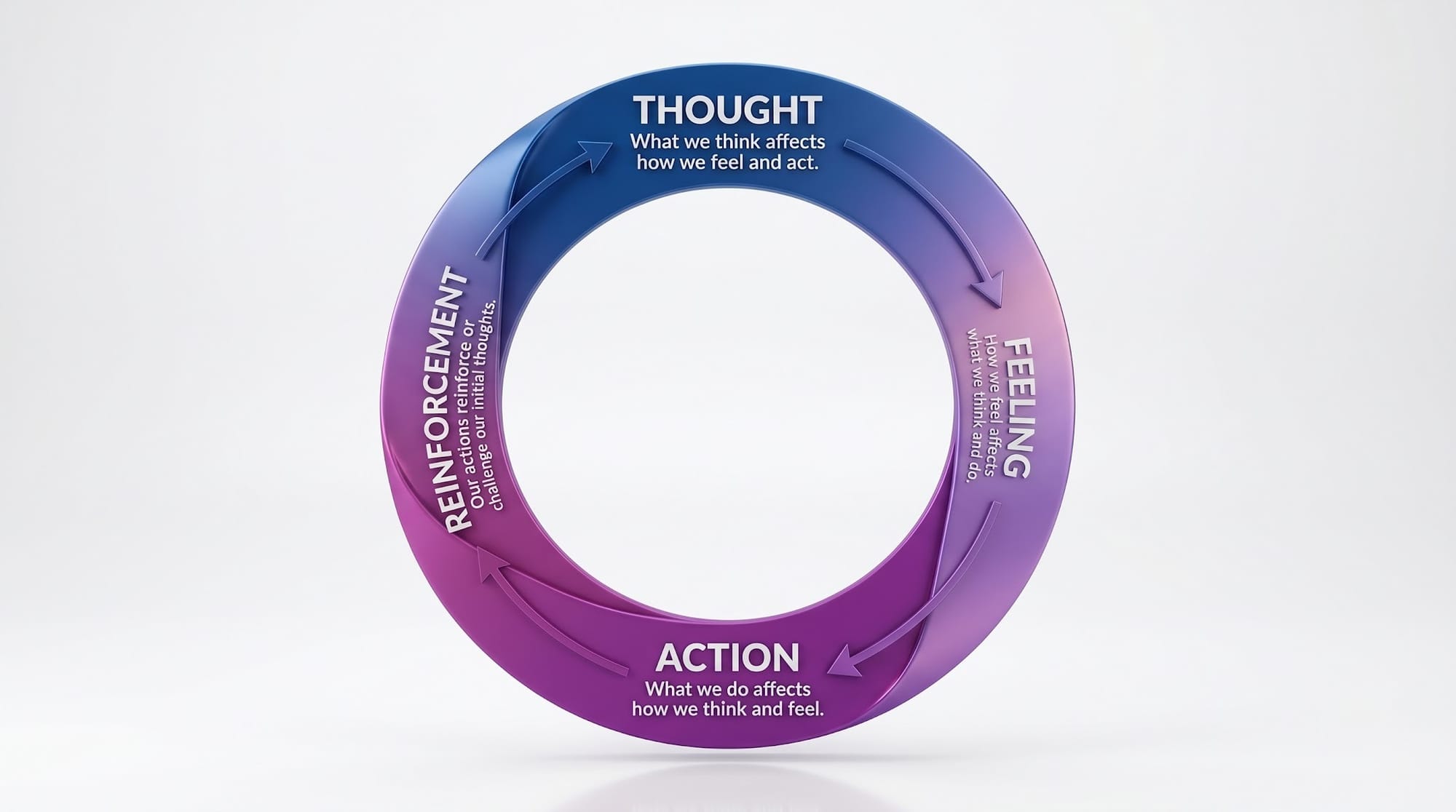
Figure 2: The Thought-Feeling-Action Cycle, demonstrating the continuous feedback loop where cognitive patterns dictate emotional states, drive behavioral choices, and ultimately reinforce core beliefs.
A limiting belief arises (e.g., “I will fail”), which triggers an emotion like anxiety. This feeling influences your behavior, leading to avoidance or reduced effort. Finally, what happens after you act reinforces the original thought: if you do poorly because you didn't prepare, your mind claims, “I knew I would fail.” Knowing this cycle helps you see exactly where you can make a change.
Sometimes, the most powerful way to break a negative cycle is through a physical circuit breaker, shifting your body posture to interrupt a stressful momentum before it hijacks your behavior.
The 5-Second Body Reset: When you catch your mind beginning to spin into a high-anxiety loop, your analytical brain temporarily takes a back seat. To break the automatic cycle, you can change your physical state immediately. Stand up, stretch your arms wide, take three sharp, rapid exhalations, or walk to a different room. Changing your posture and breathing pattern shifts the sensory input going to your brain. This brief physical reset clears the airwaves, giving you the mental space you need to apply a bridge affirmation or clear your thoughts.
After breaking the cycle, you gain the freedom to move forward, even if you don't feel completely prepared. Embracing challenges is essential for cultivating a growth mindset, and your positive statements become authentic when backed by corresponding behaviors. Establish SMART (Specific, Measurable, Achievable, Relevant, and Time-bound) objectives to maintain focus and drive. Ultimately, while your mindset establishes the vision, your concrete actions generate the necessary progress.
🛡️ Building Resilience and Overcoming Resistance

Resilience, or bouncing back from tough times, gets much stronger when you have a positive, focused mindset. A growth mindset frames setbacks as temporary learning opportunities, challenges unhelpful patterns, prevents extreme thinking during difficult times, and supports mindfulness to help you handle discomfort without feeling overwhelmed, so that you can respond thoughtfully.
Changing old, deeply rooted habits takes time and effort, and it’s completely normal to feel some resistance or discomfort at first—this is just a natural part of growing. Here is how to navigate common challenges along the way:
- Impatience: Wanting immediate, sweeping results. Solution: Focus on consistent daily practice and celebrate small wins.
- Discouragement: Slipping back into old, automatic thought patterns. Solution: Practice self-compassion; view lapses as a natural part of the learning process rather than as a failure, and gently recommit.
- Outside Negativity: Being in an unsupportive environment. Solution: Strengthen your internal resolve, seek out supportive people and resources (friends, mentors, or communities), and limit exposure to negativity where possible.
✒️ Re-scripting Your Life Through Journaling

When a recurring frustration, creative block, or fixed-mindset phrase appears in your life, you can actively disrupt it by using Targeted Journaling to expose and rewrite the subconscious's hidden scripts.
How to Conduct a Subconscious Inquiry:
1. The Trigger: Identify the current life challenge or fixed-mindset language you keep repeating (e.g., “I'm just not good at this; it's too hard”).
2. The Deep Question: Ask yourself directly: “What underlying assumptions am I making here?” and “Where did I originally learn this specific belief?” Let the answers flow onto the page without immediate judgment.
3. The New View: Look for concrete evidence against the limitation. Write down a more balanced, expanded view (e.g., “I have faced unfamiliar roadblocks before, and I can develop my abilities through effort and practice”).
4. The Small Action: Immediately define one tiny, manageable action step you can take within 24 hours that aligns with this new belief. Taking action breaks the old loop and builds physical momentum to back up your mental shift.
🌅 Conclusion: Designing Your Bright Future
Your thoughts might seem automatic, but your real power is in how you choose to respond to them. When you build self-awareness, challenge old patterns, and replace them with helpful beliefs using tools like visualization, journaling, and affirmations, you unlock more of your true potential. By doing this regularly, you create a life that fully matches your deepest values.
Remember this core truth: “All that I am is the result of what I have thought.” Your thoughts aren’t just background noise—they’re powerful seeds that shape your brain, your actions, and your life. Choose to care for them each day, because what you think, you become.
Your Journey Starts Now
Start making small, conscious changes to your reality today. Pick just one limiting belief that’s holding you back. Notice it, question if it’s really true, and write down three reasons why this belief might not be accurate.
Then, choose one small action you can take today—like a 5-minute heart-centered alignment, a targeted journal entry, or repeating a bridge affirmation with genuine feeling—to help your thoughts and actions match the future you want to build.
“Our actions and decisions today will shape how we will live. And so it is.”
Disclaimer: The information, exercises, and practices shared in this post—including visualization, breathing techniques, and mindset tools—are for educational, informational, and self-improvement purposes only. This content is not intended to be a substitute for professional medical advice, diagnosis, or treatment, nor is it a substitute for professional mental health care. Always seek the advice of your physician, licensed therapist, or other qualified healthcare provider with any questions you may have regarding a medical or psychological condition. Never disregard professional advice or delay seeking it because of something you have read here.
If my writing made you pause, smile, or think, I’d love your support:
Your support helps me keep writing and sharing these ideas with you.
📚 Recommended Reads & Resources

Books (via Izalgo Bookstore)
Scientific Foundations & Neuroplasticity
- Mindset: The New Psychology of Success by Carol S. Dweck, Ph.D.: The foundational blueprint for the growth versus fixed mindset paradigm is cited explicitly in the text. Dweck explains how our beliefs about our capabilities directly dictate our behaviors, resilience, and ultimate success, providing rigorous psychological evidence that human intelligence and skills can be systematically developed through persistence and focused effort.
- The Emotional Life of Your Brain by Richard J. Davidson, Ph.D., and Sharon Begley: An empirical exploration of the brain mechanisms that govern emotional styles and neuroplasticity. This work offers a scientific bridge, demonstrating how targeted mental training can alter neural circuitry and validating the text's assertions about biological baseline shifts, self-awareness, and the cognitive-emotional pathways that shape our daily reality.
- Breaking the Habit of Being Yourself: How to Lose Your Mind and Create a New One by Dr. Joe Dispenza: Serving as the direct operational sequel to the concepts of neural restructuring, this book bridges quantum physics, neuroscience, and genetics to show that your genes do not hardwire you to be a certain way for the rest of your life. Dispenza details how thoughts dictate a recursive chemical cycle of feeling and memorized behaviors, providing a highly practical, step-by-step formula to intentionally dismantle the old "memory of yourself" and structurally map a new mind for a more fulfilling reality.
- The Brain That Changes Itself by Norman Doidge, M.D.: Grounded in the revolutionary discovery of neuroplasticity, this book highlights how the human brain is highly adaptable, capable of rewiring its structural pathways in response to deliberate thought and action. It underscores the scientific reality that consistent positive thinking and learning can fundamentally reshape our mental hardware over time, thereby supporting the core themes of your text.
- Chatter: The Voice in Our Head, Why It Matters, and How to Harness It by Ethan Kross: Explores the silent conversations we have with ourselves, delving into the neurological roots of our inner dialogue and its profound impact on our emotional equilibrium. It offers science-backed frameworks to transform the inner critic into an inner coach, directly mirroring the practice of shifting from a fixed mindset to an agile, growth-oriented perspective.
Metaphysical & Holistic Theories
- The Biology of Belief: Unleashing the Power of Consciousness, Matter & Miracles by Bruce H. Lipton, Ph.D.: A groundbreaking text that bridges microbiology with holistic quantum theories. Lipton demonstrates how cellular biology is influenced not simply by genetic coding but also by our perceptions and energetic environment, aligning perfectly with the concept that our subjective interpretation of reality directly governs our physical expression and well-being.
- The HeartMath Solution by Doc Childre and Howard Martin: An essential guide explaining the energetic field of the heart and its direct communication with the emotional brain. The authors provide the theoretical framework for heart-brain coherence, explaining how cultivating elevated feelings, such as appreciation, shifts heart rate variability into an integrated pattern that stabilizes the central nervous system.
- Becoming Supernatural: How Common People Are Doing the Uncommon by Dr. Joe Dispenza: Expanding on the intersection of science and mysticism, this book explores how humans can transcend their physical constraints by tuning into higher frequencies of consciousness. It maps out exactly how elevating one’s emotional energy can physically heal the body and actively draw new, desired experiences into one’s life through energetic resonance.
- The Field: The Quest for the Secret Force of the Universe by Lynne McTaggart: This book, written as a scientific detective story, presents a compelling picture of an interconnected universe governed by an all-encompassing quantum energy field. It provides a robust, evidence-based backdrop for the power of human intention, demonstrating that our thoughts are powerful energetic signals that dynamically interact with the world around us.
- Vibrational Medicine: The #1 Handbook of Subtle-Energy Therapies by Richard Gerber, M.D.: Considered the definitive encyclopedia of energetic healing, this work bridges traditional anatomy with holistic frequency modalities. It provides a deep dive into how human beings function as complex networks of subtle energy, beautifully validating the concept that shifting our mental frequency through intention directly alters our physical and emotional health.
Practical "How-To" Elements
- Atomic Habits: An Easy & Proven Way to Build Good Habits & Break Bad Ones by James Clear: The definitive practical manual on behavioral architecture and identity-based habits. Clear's frameworks provide actionable methods for implementing daily disciplines, such as the "Garden Ritual" described in the text, focusing on how tiny, manageable shifts break destructive loops and cultivate long-term neural and behavioral transformation.
- Feeling Good: The New Mood Therapy by David D. Burns, M.D.: A highly practical clinical workbook detailing Cognitive Behavioral Therapy (CBT) techniques. This guide directly aligns with the text's "Weeding" phase and unhelpful thought-pattern disruptions, teaching readers how to systematically write down, challenge, and dismantle automatic negative scripts and cognitive distortions using empirical evidence.
- The Mindful Self-Compassion Workbook by Kristin Neff, Ph.D., and Christopher Germer, Ph.D.: Translating the science of self-compassion into actionable exercises, this workbook offers direct tools for handling resistance, discouraging setbacks, and the friction of growth. It provides a gentle, structured approach to reprogramming the subconscious mind with kindness, allowing individuals to navigate the challenging journey of mindset transformation without harsh self-judgment.
- The High 5 Habit: Take Control of Your Life with One Simple Habit by Mel Robbins: Distilling the science of motivation down to profound, simple daily actions, this book introduces an instant physical circuit breaker to build self-trust. It practically demonstrates how anchoring small, celebratory physical habits can quickly interrupt negative self-talk loops and propel immediate, confident momentum.
- The Power of Habit: Why We Do What We Do in Life and Business by Charles Duhigg: Delving into the foundational loop of cue, routine, and reward, this guide provides a practical blueprint for identifying and systematically changing subconscious behavioral loops. It serves as an essential manual for anyone looking to intentionally design their actions to align with their newly cultivated mindset and override automatic default behaviors.
Online Resources
Scientific Foundations & Neurological Research Tools
- HeartMath Institute (Inner Balance): This platform provides biofeedback technology and training programs designed to measure and optimize Heart-Brain Coherence. The tools guide users through rhythmic thoracic breathing and emotional shifting exercises, visually demonstrating how calming the heart field systematically dissolves stress, alters heart rate variability, and downregulates the amygdala's fear-based cortisol cascades.
- Muse: Functioning as a clinical-grade EEG biofeedback headband and companion app, Muse uses advanced sensors to measure real-time brainwave activity during meditation. It provides immediate auditory feedback to help users discern when their minds are actively wandering versus when they are deeply focused, aligning with the scientific need to cultivate a baseline of synchronized, relaxed neural rhythms.
- Brain.fm: Powered by rigorous neurological research, this functional music platform uses AI-generated audio designed specifically to steer brainwave activity into states of deep focus, relaxation, or sleep. It offers a practical, effortless way to manipulate the brain’s energetic frequency, instantly supporting neuroplasticity and the mental clarity needed for effective visualization practices.
- Huberman Lab: Hosted by neurobiologist Dr. Andrew Huberman, this expansive digital platform and podcast breaks down complex neuroscience into free, highly actionable protocols. It serves as an exceptional resource for learning how to leverage dopamine behaviorally, manage cortisol, and use visual and respiratory tools to rewire the brain for sustained growth and emotional intelligence.
Metaphysical & Holistic Energetic Platforms
- Insight Timer: Functioning as the world's largest free library of guided practices, this application features specialized tracks for multidimensional visualization, gratitude cultivation, and progressive muscle relaxation. It provides the precise environmental framework needed to perform daily mental rituals, helping users ground their awareness, seed energetic intentions, and anchor elevated emotional states.
- Mindvalley: This premier educational platform curates highly immersive courses that blend modern science, holistic health, and esoteric energy practices. Offering masterclasses on everything from energetic healing to subconscious reprogramming, it provides a comprehensive digital ecosystem for those looking to expand their metaphysical toolkit and architect a profoundly intentional life.
- Gaia: A streaming service dedicated to conscious media, Gaia offers thousands of documentaries, guided practices, and series exploring the intersection of quantum physics and ancient spiritual wisdom. It serves as a comprehensive visual library for individuals seeking to deepen their understanding of energetic frequencies, the hidden mechanics of the subconscious mind, and human potential.
- The Tapping Solution: This platform digitizes Emotional Freedom Technique (EFT), beautifully combining the holistic principles of Chinese acupressure with modern psychology. Guiding users to tap specific meridian points while physically vocalizing bridge affirmations serves as a powerful somatic tool to rapidly release energetic blockages and overwrite deeply rooted subconscious limiting beliefs.
- Izalgo: This platform acts as a dedicated environment for exploring the harmonious integration of scientific, holistic, and metaphysical perspectives. Through in-depth resources and practical advice, it serves as a central hub that helps users move from daily tension to deep inner tranquility by presenting these paradigms as interconnected facets of a single universal truth.
Practical "How-To" Action & Somatic Tools
- Open Therapy & Breathwork: Serving as a digital somatic ecosystem, this tool offers guided breathwork, meditation, and movement sequences. It is an excellent operational resource for performing physical circuit-breaker actions, such as rapid resets, enabling users to quickly alter sensory input, reset the autonomic nervous system, and seamlessly clear high-anxiety cognitive loops through structured breathing.
- Day One Journaling: A secure, premium digital journaling application, this platform offers highly customizable templates perfectly suited for targeted subconscious inquiry. Users can build structured prompts to systematically isolate behavioral triggers, investigate underlying subconscious assumptions, record counter-evidence, and commit to immediate, actionable physical steps.
- NEUROFIT: Designed as a daily nervous-system coaching application, NEUROFIT uses brief somatic exercises and biometric measurements to help users quickly shift out of fight-or-flight stress responses. By emphasizing short, physical interventions, it puts the concept of the somatic circuit breaker into practice, rapidly lowering the body's defensive state to allow for cognitive clarity and intentional action.
- Habitica: This productivity application gamifies habit formation by treating real-life goals and daily rituals as a role-playing game. It provides a highly engaging, structured environment for users to track their daily mental "weeding and planting" rituals, seamlessly bridging the gap between abstract mindset intentions and the concrete, measurable actions required to build sustained momentum.
- SoBrief: An AI-powered platform that lets users quickly grasp the key takeaways from foundational books on energy management and well-being in about 10 minutes. It is highly useful for rapidly absorbing practical concepts and integrating the core theories of neuroplasticity and habit building into a demanding, busy daily routine.
- Audiobook preview of The Field by Lynne McTaggart: This preview offers a helpful auditory introduction to the scientific investigation of the interconnected energy fields mentioned in the metaphysical recommendations above.
Approach all books and resources with an open mind, recognizing that no single source is definitive, complete, or free from controversy and debate. Trust your intuition and inner guidance to discern what truly resonates with your personal path. If a concept or historical detail does not align with your truth, you are encouraged to disregard it and prioritize what best serves your growth.
SoBrief.com is an AI-powered digital platform that provides concise summaries of an extensive catalog of books, enabling users to grasp a book's key takeaways in about 10 minutes.
🔗Affiliate Note: Some links may be affiliate links, which means we may earn a small commission at no extra cost to you. Your support helps us continue this creative and healing work. Thank you!
Izalgo co-created the images herein with AI-powered software.
Copyright ©️IZALGO, LLC. All Rights Reserved