A Meditation On Time
Tired of battling the clock? Time isn’t just a strict schedule—it’s an experience you can bend. Discover the somatic and neural secrets to escaping frantic deadlines and unlocking deep, timeless presence.

Bending Clock Time: The Science, Spirit, and Somatic Secrets of the Everlasting Now
Have you ever felt swept up by the pace of daily life, as if time keeps slipping away? This feeling goes beyond just needing better time management. It could mean you’re looking to find more calm and presence in your life. Many of us spend time dwelling on past regrets or future worries, which makes it tough to enjoy the peace of the present.
Sarah used to feel stressed by constant deadlines and a long to-do list. Even when she finished her work, she still felt behind. After she began meditating, her outlook changed. She stopped just trying to control her time and started seeing it differently. Her mind became calmer, her regrets faded, and her anxiety lessened. She began to enjoy life more, finding peace in each moment.
Many of us learn to see time as something we must battle, always urging us forward. But there could be another way. Meditation can help us experience life more fully and meaningfully. In this article, we’ll explore how meditation and time are linked, drawing on ideas from ancient wisdom, holistic health, and modern science. This journey can bring more presence, calm, and spiritual depth to our lives.
⏳ The Grand Illusion: How We Construct Time

Meditation isn’t just for relaxation. It can actually change how we feel about time. When we turn our attention inward, the usual boundaries between past, present, and future can blur. Our minds shape our sense of time. Many people who meditate say they feel less pressure from the clock, a feeling that mystics and philosophers have explored for centuries.
Two Ways of Experiencing Time: Chronos and Kairos
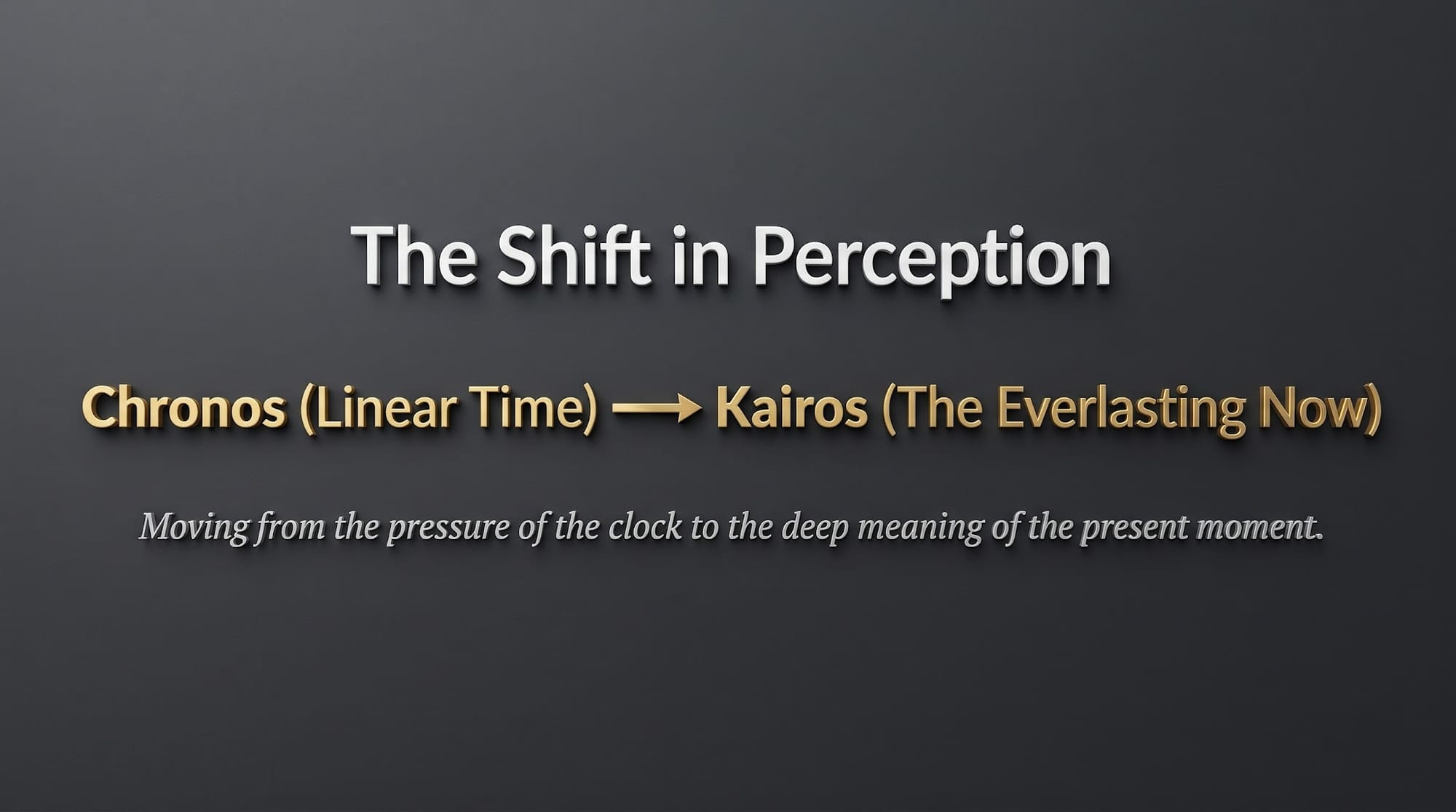
Ancient Greek thinkers drew a crucial distinction between two types of time:
- Chronos is the kind of time we measure with clocks and calendars, shaping our daily routines. Society often focuses on managing this type of time, which can feel strict and relentless. Yet, many of us long for something more than just following a schedule.
- Kairos is the 'right moment,' when the present feels deeply meaningful. It’s when we have important insights, feel truly connected, or become so absorbed in what we’re doing that we lose track of time. In these moments, the boundary between ourselves and the world softens, reminding us that strict time is something our minds create.
The Practice: Five-Minute Coherence Activation
Instead of just waiting for Kairos to happen, you can intentionally shift into this timeless state by using a gentle focus to align your physical body and subtle energy fields.
- Step 1: Heart-Focused Attention. Direct your conscious awareness away from the mind's internal clock and lock it into the center of your chest. Place a hand over your heart if it helps anchor your focus.
- Step 2: Heart-Focused Breathing. Begin breathing slightly deeper and slower than usual. Inhale for 5 seconds and exhale for 5 seconds. Find a smooth, steady rhythm that feels effortless—mimicking the natural, unforced cycles of Wu Wei.
- Step 3: Heart-Focused Feeling. Rather than forcing an abstract emotion, recall a simple, comforting sensory memory: the feeling of warm sun on your skin, the quiet stillness of early morning coffee, or a specific moment of shared laughter. Awaken that precise feeling in your chest as you breathe.
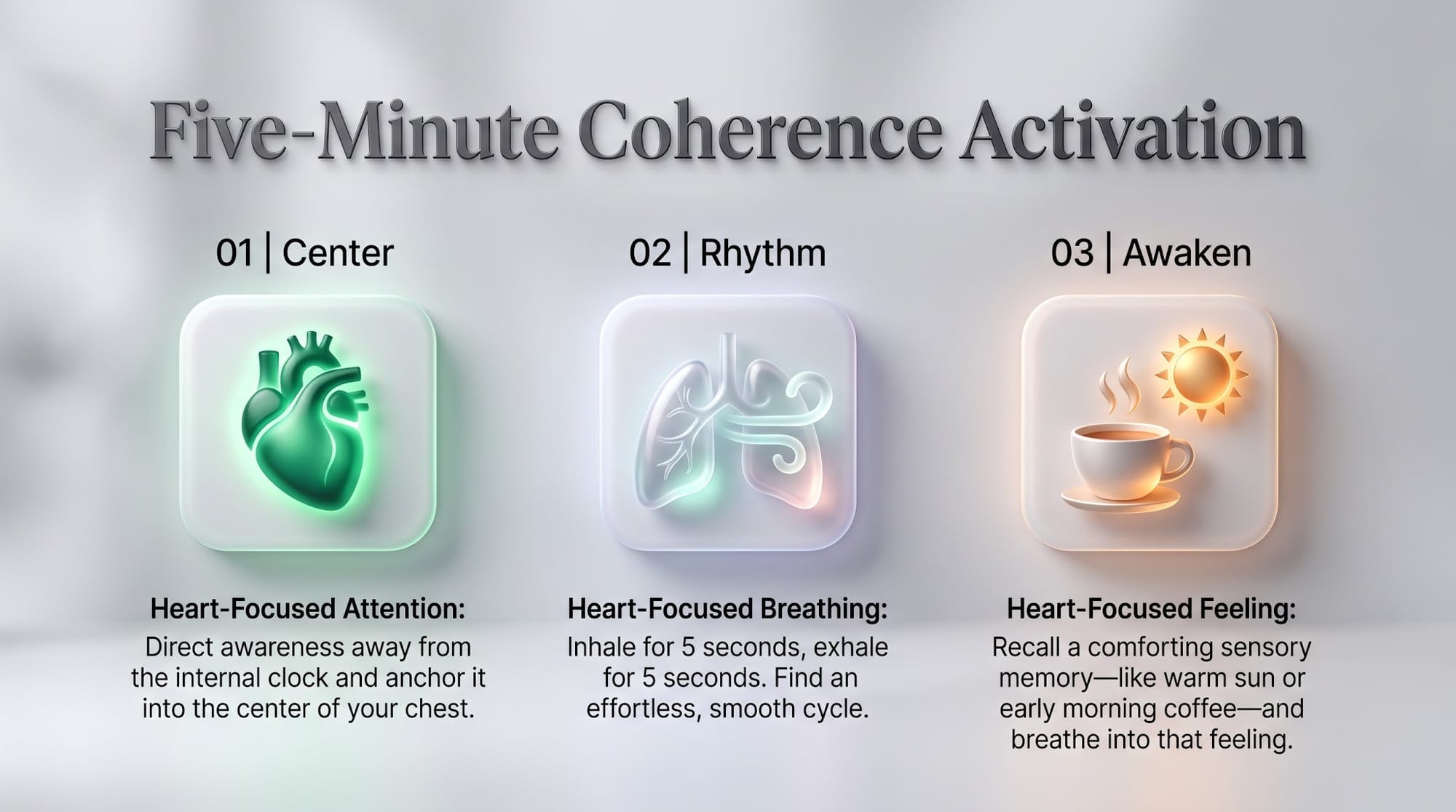
Metaphysical Insight: This practice synchronizes your heart's natural rhythms with your mind, shifting you out of the frantic, analytical processing of linear time (Chronos) and opening the doorway to higher perception (Kairos). You can use this as a "Micro-Coherence" trigger by practicing it for just three breath cycles right before opening your inbox, starting a commute, or answering a phone call.
The Cosmic Cycle: Finding Your Rhythm
In Hinduism and Buddhism, time is viewed as a cycle that repeats through life, death, and rebirth. The idea of Samsara, or endless wandering, situates our lives within the soul's larger journey. We can notice these cycles in our breathing, the changing seasons, and the Earth’s movement. Meditation lets us step out of the rush of straight-line time and find a quiet place within, where we can watch life without being carried away.
🧠 The Neurological Science of Everlasting Presence

When you meditate deeply, the idea of the 'eternal now' becomes something you can truly feel. The boundaries between past, present, and future blur, and you experience a sense of timelessness. As your thoughts quiet, you discover a calm presence that has always been there.
Science now supports what meditators have long said: meditation changes how we sense time. It quiets the brain’s default mode network (DMN), which handles thoughts about the past and future. You can think of the DMN as your mind's busy "worry center." When this center quiets down, your brain drops into a peaceful, receptive state, causing your usual sense of time to fade. Such shifts in brain activity explain why a short meditation can feel long, or a long one can pass quickly. Studies show that meditators often overestimate the length of short periods. Long-term meditators sometimes feel as if time stops completely, which aligns with reduced activity in the brain’s time centers.
Practicing regularly helps us pay better attention, making daily moments feel richer. It can also help with time perception problems, especially for people with anxiety or depression, and many say they feel more patient while waiting. Over time, regular meditation leads to better emotional balance and a healthier relationship with time.
The Body and Harmonizing with the Cosmos
While our minds often drift to the past or future, our bodies keep us in the present. The body doesn’t know yesterday or tomorrow; it only knows now. In our everyday health, what ancient traditions call 'energetic memory' manifests physically as muscle tightness, chronic tension, and a body trapped in a loop of past stress. Mindful movement and body-based practices help us release this stored tension and return to a state of calm. With regular practice, we learn to move with life’s natural flow.
"The body doesn’t know yesterday or tomorrow; it only knows now. When the mind's worry center quiets down, the brain drops into a peaceful, receptive state, causing our usual sense of time to fade."
The goal isn’t just to accept things as they are, but to choose to align with a larger rhythm. The Taoist idea of Wu Wei, or 'effortless action,' teaches us to move with life’s flow rather than resist it. Such alignment is similar to what psychologists call 'flow states,' linking ancient wisdom with our modern ability to shape our lives on purpose.
The Practice: The Meditative Stillness Scan
To explicitly dissolve "energetic memory" and signal your body to drop its historical weight in real-time, you can use a targeted, gentle release technique:
- The Preparation: Lie flat on your back in a safe, quiet space. Close your eyes and take three clearing breaths, exhaling fully through your mouth.
- Locating the Block: Slowly scan your awareness from your toes to the crown of your head. Look for subtle density, tightness, or a physical sensation of "holding" time—often found in the jaw, shoulders, or gut.
- The Conscious Compression: Instead of trying to force the muscle to relax, breathe directly into the sensation. On the inhale, intentionally tighten that specific area even further, then hold your breath for 3 to 5 seconds to gather and isolate the tension.
- The Command of Release: On a long, slow exhale, let the contraction drop away completely. Visualize the stagnant, historical energy dissolving into clear light as the tissues soften. Use the internal affirmation: "I release the past from my form; I am fully present in this vessel."
Navigating Ego Resistance
As you begin meditating, be gentle with yourself. Learning to be present can be challenging. You might feel bored, restless, or hear thoughts like, "You're wasting time! You have so much to do!" It is natural for the mind to gravitate toward the past or future due to long-standing habits. The open space of the present can feel strange at first. If you notice resistance, don’t fight it. Just observe it kindly. Feeling this way doesn’t mean you’re failing; it means real change is happening.
The Practice: The Three-Step Temporal Reset
When the mind screams that you are running out of time, step out of the frantic loop of Samsara by shifting your perception from compressed time to open space:
- Acknowledge without Judgment: Notice the rushing thought. Label it silently: "The mind is projecting Chronos."
- The Pivot to Space: When temporal anxiety strikes, our eyes tend to lock onto a single point in a stressed stare. Break this loop instantly by softening your eyes and opening your peripheral vision—notice the space to your left, right, above, and below. This easy shift instantly signals your body that it is safe to relax. Simultaneously, anchor your awareness to the closest sound you can hear.
- The Step-by-Step Action: Resume your previous task, but deliberately slow your physical movements down by just 10% for the next two minutes. Turning the chore into a sacred, deliberate ritual allows you to step directly into a calm flow state.
To deepen your engagement further, consider journaling on these questions:
- What does time feel like to you—a friend, a foe, or a neutral force?
- Recall a moment when time seemed to disappear entirely (an experience of Kairos).
- What were you doing, and how can you invite more of that quality into your life?
- If your 'past' is a collection of memories and your 'future' is a collection of imaginings, where do you exist, independent of those thoughts?
🌌 Unified Conclusion: Awakening to Your Timeless Self

Meditation helps us shift from seeing time as a struggle (Chronos) to enjoying the present moment (Kairos). It allows us to see time as a gentle guide instead of something to fight. Changing how we view time benefits us and those around us. When society values only Chronos and constant productivity, it can lead to burnout and unfairness. By focusing on meaningful moments, we bring fresh energy to our lives and communities. Our conversations become deeper, our work feels more rewarding, and our relationships grow stronger. Finding peace in the present helps us connect more and build a kinder world.
To transform your relationship with time and begin your journey, integrate these simplified practices into your daily life:
- Create a Calm Space and Commit: Start today by setting aside just five minutes for daily meditation in a quiet place where you feel safe and relaxed.
- Mindful Breathing: Sit comfortably, close your eyes, and take a few deep breaths. Focus on your breathing to keep your attention in the present. If your mind wanders, gently bring it back.
- Body Scan and Visualization: Lie down and slowly bring your attention to each part of your body, letting go of tension without judging yourself. Or picture your worries and regrets as leaves floating down a river, and watch them pass calmly.
- Daily Mindfulness: Walk slowly and notice each step. Eat slowly and enjoy every bite. During your commute, focus on what you see and hear instead of thinking ahead. When talking with others, listen carefully and give them your full attention.
As you walk this path, keep this timeless wisdom in mind:
"Realize deeply that the present moment is all you ever have." — Eckhart Tolle
"The present moment is filled with joy and happiness. If you are attentive, you will see it." — Thich Nhat Hanh
"Be here now." — Ram Dass
Take a deep breath, bring your attention to the present, and notice the simple beauty around you right now.
“Our actions and decisions today will shape how we will live. And so it is.”
Disclaimer: The information, somatic practices, and meditations presented in this article are for educational and informational purposes only and do not constitute medical, psychological, or professional health advice. Please consult with a qualified healthcare provider before beginning any new breathwork, physical practice, or wellness routine, especially if you have underlying health conditions.
If my writing made you pause, smile, or think, I’d love your support:
Your support helps me keep writing and sharing these ideas with you.
📚 Recommended Reads & Resources

Books (via Izalgo Bookstore)
Scientific Foundations of Presence and Time Perception
- The Order of Time by Carlo Rovelli: This book dismantles the traditional notion of linear time, explaining how modern physics views time not as a uniform, universal flow, but as a complex web of events. By showing that the separation between past, present, and future is an illusion on a cosmic scale, the text provides a rigorous scientific foundation for its deep exploration of Kairos and the timeless state experienced during deep meditation.
- Altered Traits: Science Reveals How Meditation Changes Your Mind, Brain, and Body by Daniel Goleman and Richard J. Davidson: Grounded in decades of neuroscientific research, this work demonstrates how regular meditation permanently alters brain circuitry, shifting practitioners out of the default mode network (DMN). It serves as a foundational text for understanding how the brain's "worry center" relaxes during mindfulness, validating the text's claim that long-term practice alters real-time neurological time perception.
- Your Brain Is a Time Machine: The Neuroscience and Psychology of Time by Dean Buonomano: This book explores how the human brain is fundamentally an organ designed to navigate, construct, and remember time. It provides critical insight into how our subjective experience of time is generated by neural architecture, offering excellent scientific context for the text's discussions on how ego resistance and stress alter the perceived velocity of daily life.
- Breath: The New Science of a Lost Art by James Nestor: An investigative look into how autonomous breathing patterns dictate human physiology, nervous system states, and emotional health. This text establishes the underlying biological mechanisms of the Five-Minute Coherence Activation, demonstrating how controlled, rhythmic breathing directly influences heart rate variability and shifts the body out of survival-driven, linear patterns.
Metaphysical Traditions and Timeless Philosophy
- The Power of Now: A Guide to Spiritual Enlightenment by Eckhart Tolle: A modern spiritual masterpiece centered entirely on the concept that the present moment is the only true reality. It echoes the text's core message by mapping out how the analytical mind constructs the illusions of past and future (Chronos), offering a profound philosophical blueprint for dissolving ego resistance and awakening to the timeless self.
- The Tao of Pooh by Benjamin Hoff: This accessible introduction to Western Taoist thought elegantly unpacks the concept of Wu Wei, or "effortless action." The book serves as a perfect philosophical bridge to the text's holistic dimensions, showing how moving with life’s natural current, rather than fighting against linear schedules, allows individuals to step fully into deep, restorative flow states.
- Be Here Now by Ram Dass: A seminal text on spiritual awakening that details the journey from Western hyper-productivity to Eastern mindfulness. It serves as an excellent companion to the text's discussions of the cosmic cycle, illustrating how shifting consciousness allows us to view life from a place of quiet internal stillness without being swept away by the frantic pace of external society.
- Peace Is Every Step: The Path of Mindfulness in Everyday Life by Thich Nhat Hanh: This book translates ancient Buddhist insights into gentle, everyday practices, demonstrating how ordinary routines can become sacred rituals. It underscores the text's recommendations for transforming mundane daily chores into conscious, deliberate steps toward an everlasting now, showing how presence naturally fosters a kinder, more connected world.
Practical Somatic and Meditative Frameworks
- The Body Keeps the Score: Brain, Mind, and Body in the Healing of Trauma by Bessel van der Kolk: A definitive guide to how the body stores historical stress, tension, and emotional blockages. This work provides the exact developmental framework for understanding the text's concept of "energetic memory," illustrating why body-centered awareness is an essential tool for releasing chronic muscular holding patterns and returning to the present.
- Waking the Tiger: Healing Trauma by Peter A. Levine: This book introduces somatic experiencing and explores how active physical awareness and instinctual movement can discharge trapped, past-oriented stress responses in the nervous system. It serves as a direct, practical foundation for the Meditative Stillness Scan, reinforcing the vital truth that the physical body only exists in the immediate "now."
- Accessing the Healing Power of the Vagus Nerve by Stanley Rosenberg: A practical guide offering simple, autonomous exercises designed to regulate the vagus nerve and instantly trigger a state of physiological safety. It perfectly complements the somatic circuit breakers outlined in the text, giving readers clear, physical tools to soften their gaze, shift their peripheral vision, and down-regulate panic in real time.
- Radical Acceptance: Embracing Your Life With the Heart of a Buddha by Tara Brach: Focused on using mindful presence to navigate emotional discomfort and mental loops without self-judgment. This framework provides invaluable practical guidance for navigating ego resistance, boredom, and restlessness that naturally arise when an individual attempts to slow down their personal timeline.
Online Resources
Heart-Brain Coherence and Breath Regulation
- HeartMath Institute: Offers specialized biometric technologies, apps, and educational toolkits to track and improve heart rate variability (HRV). This platform provides the precise technical and educational support needed to master the text's Five-Minute Coherence Activation, allowing users to physically visualize their shift from frantic linear thinking to balanced Kairos.
- Breathwrk: A mobile application featuring curated, science-backed breathing exercises designed to alter physical and emotional states. The tool provides a visual pacing system that matches the 5-second inhale and 5-second exhale patterns highlighted in the text, serving as an easily accessible digital anchor for real-time stress reduction and energetic harmonizing.
- Paced Breathing: A streamlined audio-visual breathing coach that lets users program custom inhalation, exhalation, and retention intervals. It serves as an ideal, non-intrusive utility for establishing the steady breathing rhythms needed to mimic Wu Wei, helping professionals seamlessly integrate short coherence breaks into their daily work schedules.
- Respirelax+: A dedicated respiratory training tool designed to help users guide their autonomic nervous system into a state of cardiovascular coherence. It directly supports the text's holistic directives by providing a free, hyper-focused interface that strips away digital clutter, encouraging pure presence during quick temporal resets.
Somatic Mindfulness and Nervous System Reset
- Open: A modern digital studio blending breathwork, targeted movement, and meditation into high-impact, immersive sensory sessions. The platform focuses heavily on somatic circuit breakers and deep body awareness, mapping directly to the text's recommendations for physically releasing stored "energetic memory" through real-time physiological practices.
- Curable: An app-based program that combines neurosomatic tracking, biopsychosocial education, and cognitive tools to help users untangle chronic physical tension from past psychological stress patterns. It perfectly operationalizes the Meditative Stillness Scan concept by training individuals to consciously compress, isolate, and release bodily holding patterns.
- Yoga International: A massive repository of somatic movement classes, systematic relaxation guides, and deep physical scanning sessions. This resource is highly useful for individuals seeking to ground their minds in their bodies, offering a variety of movement pathways that help break down long-standing ego resistance and physical tightness.
- Insight Timer: An expansive meditation app hosting thousands of free yoga nidra, body scan, and ambient soundscape tracks. It allows users to easily customize silent meditation timers with gentle acoustic bells, making it an excellent platform for building daily meditation habits. These self-directed stillness rituals step entirely outside the bounds of scheduled Chronos.
Daily Rituals and Presence Training
- Waking Up: A curated philosophical and meditative platform created by Sam Harris that goes beyond basic relaxation to explore the true nature of consciousness. Its brief daily sessions explicitly target how the human mind constructs time and the self, serving as an outstanding companion tool for dissolving the mental barriers between past and future.
- Calm: Provides a structured suite of daily mindfulness tracks, focus soundscapes, and breathing exercises designed to gently break up modern cognitive fatigue. The tool assists users in cultivating micro-presence, making it highly effective for applying the text's Three-Step Temporal Reset during a busy commute or right before checking a morning inbox.
- The Plum Village App: A completely free digital companion offering mindfulness bell utilities, walking meditations, and contemplation practices derived directly from Zen tradition. The tool is explicitly designed to inject brief moments of sacred awareness into everyday activities, helping users turn routine chores into grounding, present-moment rituals.
- Habitify: A minimalist routine tracking platform focused on building sustainable, life-affirming daily habits. Rather than gamifying life to maximize frantic productivity, it can be used to protect sacred pockets of unmeasured time, reminding users to slow their physical movements by 10% and to consistently implement their daily somatic resets.
Concise Learning & Summaries
- SoBrief.com: An AI-powered platform that helps you quickly grasp the key takeaways from books on energy management and well-being in about 10 minutes.
- Izalgo Bookstore: A curated digital space to find specific titles on holistic health and spiritual growth.
- Izalgo: This platform is a dedicated environment for exploring the harmonious integration of scientific, holistic, and metaphysical perspectives, presenting them as interconnected facets of a single truth. Through in-depth resources, it provides a central hub of concrete tools and practical advice to help you move from tension to deep inner tranquility.
Approach all books and resources with an open mind, recognizing that no single source is definitive, complete, or free from controversy and debate. Trust your intuition and inner guidance to discern what truly resonates with your personal path. If a concept or historical detail does not align with your truth, you are encouraged to disregard it and prioritize what best serves your growth.
SoBrief.com is an AI-powered digital platform that provides concise summaries of an extensive catalog of books, enabling users to grasp a book's key takeaways in about 10 minutes.
🔗Affiliate Note: Some links may be affiliate links, which means we may earn a small commission at no extra cost to you. Your support helps us continue this creative and healing work. Thank you!
Izalgo co-created the images in this post using AI software.
Copyright ©️IZALGO, LLC. All Rights Reserved