How refreshing to hear the whinny of a packhorse when its burden is lifted off its back!
A packhorse’s whinny isn’t just a sound—it’s a vibration of freedom. Explore how this metaphor reveals the biology of somatic release and the metaphysics of energy, with practical steps to stimulate the Vagus Nerve, clear your Throat Chakra, and reclaim your wild spirit.


Key Takeaways
- A horse’s whinny is like a human sigh. Both help the body reset by releasing CO2 and signaling to the nervous system that it’s safe.
- Making a sound when you let go helps reset your fascia. The vibration tells your cells to move from stress to healing.
- A deep sigh turns on the body’s “Vagal Brake,” helping you shift from survival mode to deep rest by activating the Ventral Vagal system.
- On a metaphysical level, letting go moves your energy center back to your heart, helping you balance your everyday self with your wild spirit.
- The “Drop the Load” challenge asks you to name a burden, do a physical release ritual, and finish with a clear sigh.
🐎The Whinny of Freedom: The Biophysics and Metaphysics of Unburdening

Have you ever really listened to a horse’s whinny, especially when a packhorse is freed from its load? It’s more than just a sound; it’s a clear sign of relief.
Think about the deep sigh you let out after a tough day. We often say, "Sorry, it’s just been a long day," but that sigh is your body’s way of resetting. This simple act holds important lessons from both science and spirituality.
This article invites you to look deeper into this idea. We’ll explore how the biology of release and the flow of energy can help us let go of our burdens and move from just surviving to truly feeling free.
🌬️The Symphony of Release: Horse Totem Wisdom

In shamanic tradition, the horse stands for drive, passion, and a love of freedom. It’s also seen as a traveler between worlds. A packhorse shows us both sides: the part of us that handles daily duties and the part that wants to be wild and free.
The whinny stands for the whole, balanced self. It’s when the horse is not just carrying a load or running wild, but is at peace with itself. Most horses sleep standing up, always alert. The whinny means it finally feels safe enough to rest. It’s a sign of true freedom.
🫁The Science of the Sigh: A Biological Reset

Even though it feels emotional, a whinny or a human sigh is actually a smart way our bodies are built to reset.
1. The Hypercapnic Reset
When we’re stressed, we breathe more shallowly, which throws off the balance of CO2 in our blood. Taking a deep sigh helps release extra carbon dioxide and quickly changes your blood chemistry. This lets your brain get a fresh boost of oxygen right away.
2. Toggling the Vagal Brake
According to Polyvagal Theory, carrying stress keeps our “Sympathetic” nervous system running nonstop. The whinny shows that the Ventral Vagal system is working again, acting like a brake to slow your heart and signal to your body that it’s safe. This signals to your body that the danger has passed, so your immune system can return to normal.
⚡Tensegrity and the Piezoelectric Effect

Our bodies are more than just flesh and bone; they’re built with tensegrity, or balanced tension. Carrying a heavy load, whether it’s a backpack or a secret, actually changes the shape of your cells.
Your fascia, the tissue around your muscles, creates a small electric charge when it’s under pressure. If you carry stress for too long, it can wear out your tissues, leaving them dry and stiff.
The vibration from a whinny or a sigh helps reset your body. This physical signal tells your cells to stop making stress proteins and start making healing ones. You’re helping your body regain flexibility.
🌀Metaphysical Interpretations: The Assemblage Point

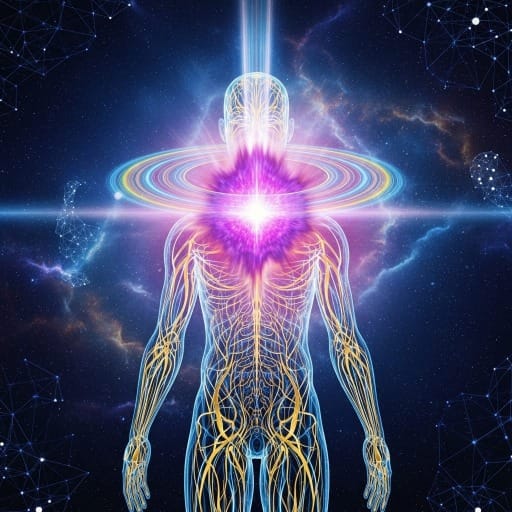
In metaphysics, people talk about the Assemblage Point, a central point in our energy field. Science calls this a Toroidal Electromagnetic Field.
When we feel weighed down, this energy center can drop or become unstable, leading us to focus on our problems. Letting go, like a whinny, brings it back to the heart.
- The Zeal Point: There is a specific energy center at the base of the skull called the "Zeal Point." This is often where we feel "the weight of the world." The whinny releases the "stranglehold" of the past here, allowing the toroidal field to become coherent again. It’s like a software update that’s been stuck at 99%, finally completing because the system cleared enough space to run the install.
🗝️7 Key Insights for the Modern Packhorse

- Release is a Requirement, Not a Luxury: Just as a horse cannot carry a pack indefinitely without breaking, your nervous system requires the "whinny" to maintain homeostatic regulation.
- Identify the "Anatomical Anchor": Every burden has a physical home. Does your "pack" live in your jaw (Masseter muscle), your solar plexus, or your pelvic floor?
- The Martyr Archetype: Ask yourself: "Is my 'helpfulness' actually a way to avoid looking at my own empty saddle?" Carrying others' loads often leads to incoherent biofields.
- Vocalize the Freedom: The sound is the key. Silence keeps the tension locked in the fascia. A sigh, a hum, or a "whoosh" moves the lymphatic fluid.
- Resonance over Resistance: When you drop the load, you stop "resisting" life and start "resonating" with it. This is the shift from Dissonant Oscillations to Constructive Interference.
- Quantum Superposition: When you stop "observing" your burdens, you allow your energy to return to a state of infinite potential. You shift from the path beneath your hooves to the horizon in front of you.
- Sovereignty is Earned: You are the one who unbuckles the straps. The universe provides the field, but you must choose to drop the pack.
🎒The 24-Hour "Drop the Load" Challenge

To turn these ideas into action, take real steps. Try doing a “System Reset” in the next 24 hours.
1. The Heavy Audit (Immediate)
Grab a pen and write down the top three burdens you’re carrying right now, like a grudge, a fear, or a draining responsibility.
The Bio-Feedback Check: As you write each one, notice where your body clenches. That is your anatomical anchor.
2. Select Your Target (5 Minutes)
Circle one thing you can let go of or hand off today.
3. The Release Ritual (By Tonight)
Do something physical to show your nervous system it’s safe:
- If it's mental: Write it down and safely burn it (Fire transmutation).
- If it's interpersonal: Send the "no" text or the forgiveness message.
- The Sound: As you do this, make a literal, audible sigh. Feel the CO2 leave your lungs and the "vagal brake" click into place.
4. Create Accountability (By Tomorrow)
Text a friend: "I’m choosing to let go of [Insert Burden] this week to feel lighter. Check in with me on Friday to see how my ‘whinny’ sounds."
Are you ready to make the whinny your reality? Your spirit is ready to run free, but your hands must first do the work of unbuckling the load. Commit to your release in the comments below by typing: "I am dropping the load," and tell us the one specific action you will take today.
“Our actions and decisions today will shape how we will live. And so it is.”
If my writing made you pause, smile, or think, please consider:
Your support helps me keep writing and sharing these ideas.
📚Recommended Reads & Resources

Somatic Healing & The Biology of Release
These resources expand on the document's discussion of the Vagus Nerve, fascia, and "The Shake."
- "Waking the Tiger: Healing Trauma" by Peter A. Levine
- Why it fits: This is the foundational text on Somatic Experiencing. Levine specifically studies how wild animals physically "shake off" adrenaline after a threat (as described in the "whinny" and "shake" sections) and how humans can use this to release trauma.
- "The Body Keeps the Score: Brain, Mind, and Body in the Healing of Trauma" by Bessel van der Kolk, M.D.
- Why it fits: The definitive guide on how trauma is stored in the tissues and fascia ("muscle memory") and why talk therapy alone often isn't enough to unburden the spirit.
- "Accessing the Healing Power of the Vagus Nerve" by Stanley Rosenberg
- Why it fits: Offers practical exercises to stimulate the Vagus Nerve (mentioned in the blog) and help the body shift from a state of stress to a state of safety and social engagement.
Animal Wisdom & Shamanic Tradition
These resources delve into the "Horse Totem" and the concept of Soul Retrieval mentioned in the text.
- "Animal Speak: The Spiritual & Magical Powers of Creatures Great & Small" by Ted Andrews
- Why it fits: The classic encyclopedia for understanding Animal Totems, it offers deep insight into the Horse's specific spiritual meaning (travel, power, freedom).
- "The Tao of Equus: A Woman's Journey of Healing and Transformation through the Way of the Horse" by Linda Kohanov
- Why it fits: Explores the metaphysical connection between horses and humans, focusing on how horses mirror our emotions and spiritual states.
- "Soul Retrieval: Mending the Fragmented Self" by Sandra Ingerman
- Why it fits: The text mentions "Soul Retrieval" as a way to honor the wild spirit. This book explains the shamanic journey of calling back parts of the self that have been given away for safety or acceptance.
Metaphysics, Chakras, & Energy Fields
These resources cover the "Throat Chakra," "Aura," and the distinction between Karma and Dharma.
- "Eastern Body, Western Mind: Psychology and the Chakra System as a Path to the Self" by Anodea Judith
- Why it fits: A comprehensive look at the Chakra system that bridges holistic psychology with metaphysics, it is excellent for understanding the "Throat Chakra" (speaking truth) and heart-centered wounds.
- "Letting Go: The Pathway of Surrender" by David R. Hawkins, M.D., Ph.D.
- Why it fits: Directly addresses the distinction between "low-frequency energy" (burdens) and high-frequency states. It offers a technique for emotional surrender that parallels the "unburdening" theme.
- "The Seat of the Soul" by Gary Zukav
- Why it fits: A classic text that details the difference between Karma (unconscious patterns) and Dharma (authentic power and purpose), helping readers distinguish between service and servitude.
- "Anatomy of the Spirit: The Seven Stages of Power and Healing" by Caroline Myss
- Why it fits: Explains how our biography becomes our biology—how emotional burdens and beliefs impact our physical health and energy field.
Online Resources & Practices
- TRE® (Tension & Trauma Releasing Exercises)
- Website: traumaprevention.com
- Relevance: This is the official method for "The Shake" mentioned in the blog. It teaches the neurogenic tremors that animals use to discharge stress.
- HeartMath Institute
- Website: heartmath.org
- Relevance: Provides research and techniques on "heart coherence," which relates to the text's mention of the Heart Chakra and stabilizing the body's pressure after stress.
- Insight Timer (App/Website)
- Relevance: Excellent for finding guided meditations on "Vagus Nerve Stimulation," "Chord Cutting," and "Chakra Balancing."
You can find these titles and more in our Bookstore📚.
Remember to explore these resources with an open mind and trust your intuition to find what resonates most deeply with your journey of rediscovery.
SoBrief.com is an AI-powered digital platform that provides concise summaries of an extensive catalog of books, enabling users to grasp a book's key takeaways in about 10 minutes.
🔗 Affiliate Note: Some links on this page may be affiliate-based, allowing us to earn a small commission at no additional cost to you. Your support helps fuel this creative and healing mission—thank you!
Izalgo produced the images herein with AI-powered software.
Copyright©️ IZALGO, LLC All Rights Reserved