
A Bedtime Routine
Ever wake up groggy? One in three adults misses out on the deep rest they need. Discover how to turn your nights around by beautifully weaving modern sleep science with grounding, holistic rituals to craft your ultimate sacred sanctuary.

The Metaphysics of Rest: Science-Backed Rituals to Sleep Deeply and Live Fully
Ever wake up feeling like you barely slept? Do you drag yourself through the day feeling groggy and sluggish?
You're definitely not alone. The CDC reports that about one in three adults isn't getting enough sleep, which ripples out and affects everything—our health, our productivity, and our peace of mind. It’s a bit of a paradox: many of us have trouble getting good rest, even though we know deep down how vital it is for our health and well-being.
The great news is that you absolutely can turn your nights around. By making a few simple, intentional changes to your bedtime routine and daily habits, you can wake up feeling genuinely refreshed. This guide covers seven proven strategies for better sleep, while beautifully weaving in the energetic, holistic, and spiritual sides of rest. The ultimate aim is to help you get the deep, restorative sleep you need. By learning about your sleep cycle, optimizing your bedroom, and building healthy habits, you'll unlock more energy, clearer thinking, better emotional balance, and a much stronger connection to yourself. These changes are designed to nourish you physically, energetically, and spiritually.
🔄 Understanding Your Sleep Journey: A Dance of Energy and Rest

Sleep is so much more than just lying still; it is an active, dynamic process with different stages, each critically important for your body and mind. From a holistic view, these stages are like moving through different energy states that help you recover, allowing your system to transition through different levels of awareness each night. You can think of your nervous system as the physical wiring through which this metaphysical energy flows, transforming standard biology into a deeply spiritual shift.
Each full sleep cycle lasts about 90 minutes, and we move through several of these cycles every single night. Going through these full cycles helps your body and mind completely recover, so you feel refreshed in the morning. Here’s a simple look at the four stages of sleep, viewed through both a physical and energetic lens:
🏡 Crafting Your Cozy Sleep Sanctuary

Your bedroom plays a massive role in how well you sleep, so it helps to think of it as a sacred space to relax, recharge, and renew your energy. Creating a space that intentionally supports rest can drastically improve your sleep quality. Here are some key environmental elements to consider:
- Darkness: Use blackout curtains or an eye mask, and avoid blue light, as even small amounts of light can disrupt your sleep. Lowering the lights signals your body to produce melatonin and reduces outside distractions.
- Temperature: Keep your room comfortably cool, ideally between 60 and 67°F (15 and 19°C). Staying cool is a major biological trigger for deep sleep. On an esoteric level, high heat creates physical restlessness and inflammation, which translates to a chaotic, "noisy" energetic aura. Cooling the room drops your body's speed, supporting your body's natural energetic rhythm and allowing your entire system to settle into a calmer, lower frequency.
❄️ The Biological Trigger: 60–67°F (15–19°C)
Keeping your room cool slows your body's metabolic rate. On an esoteric level, high heat creates an energetic "noisy" aura. Cooling down allows your system to settle into a calmer, lower-frequency state.
- Noise Control: Reduce disturbing sounds by using white noise machines, earplugs, or soft background music. Choose gentle, comforting sounds that actively soothe your mind and help you feel calm.
- Comfort: Invest in a good mattress, comfortable pillows, and soft bedding. Physical comfort directly helps your body relax, making it much easier to fall asleep.
- Aromatherapy: Scents like lavender and chamomile are excellent for calming your nervous system. Using these essential oils offers a gentle, aromatic way to relax your mind and body.
- Technology & Light Management: Give screens a strict break and avoid blue light for at least an hour before bed. Avoiding sudden exposure to artificial light keeps your nervous system from becoming overstimulated, allowing melatonin to flow naturally so your system can relax.
- Making Your Sleep Space Sacred: You can elevate the room's energy by adding calming crystals or safe plants. The stable, geometric atomic structures of crystals are thought to emit steady vibrational frequencies that help absorb the chaotic electromagnetic fields (EMFs) emitted by household electronics. Additionally, clearing out physical clutter can make your space feel profoundly peaceful, helping your mind feel more at ease.
🙏 Simple Evening Rituals for Mind, Body, and Spirit

Our bodies thrive on routine. Having a calming activity before bed signals to your brain that it's time to wind down, helping you let go of the day's stress and easing the transition into sleep. This mindful transition lowers your energetic frequency to a more restful state.
Some lovely, soul-nourishing pre-sleep activities to consider include:
- Reading a physical book: This is a wonderful way to escape, and it is less likely to keep your brain buzzing than a screen.
- Taking a warm bath: Immersing yourself in warm water relaxes muscles. Adding Epsom salts is excellent for physical relaxation and can even help release stagnant energy. Just as the salts physically draw out toxins via osmosis, they also act as a sponge, clearing away the literal or energetic "debris" accumulated from interactions with others throughout the day.
- Gentle stretching or yoga: This eases physical tension and encourages a beautiful sense of energetic flow. Physical muscle knots and stress can often block the flow of Chi or Prana. Stretching helps open your body's energy pathways and meridians, allowing that tension to dissolve.
- Listening to calming sounds: Soft music or nature sounds gently soothes your mind and smooths out your energetic field.
- Mindfulness and reflection: Spending time in meditation, deep-breathing exercises, or writing down what you're grateful for quiets the mind's chatter and fosters deep inner peace.
✨ Setting Your Sleep Intentions

Before you close your eyes, take a brief, conscious moment to set a positive intention for the night, such as hoping for deep rest or waking up refreshed. This simple, mindful practice can help you focus and naturally improve your sleep. You can repeat a quiet affirmation or picture yourself feeling exactly the way you want to feel in the morning. Setting an intention acts as an internal compass, guiding you toward a more peaceful night.
💭 Keeping a Dream Journal

Sleep is not just a passive break for your body to rest. It is also a sacred time when you experience dreams, which offer profound insights and help you process your deepest thoughts and feelings. Making dreamwork a regular part of your bedtime routine can be an incredibly interesting practice. Keep a dedicated journal right by your bed so you can write down your dreams the moment you wake up. Over time, you may begin to notice fascinating patterns or messages that help you understand yourself on a much deeper level.
🌙 How to Fall Asleep Faster

It can be incredibly frustrating to lie awake trying to fall asleep. To calm your mind and drift off more easily, try these practical, science-backed strategies to harmonize your internal landscape:
- Stick to a regular schedule: Go to bed and wake up at the same time, even on weekends. This consistency helps your body clock adjust, making it much easier to fall asleep each night.
- Signal your body: Build a reliable pre-bed routine, such as journaling or drinking herbal tea, to signal that it is time to relax.
- The 20-minute rule: If you can't fall asleep after 20 minutes, don't lie there tossing and turning. Get up and do something calming. Changing your environment breaks the frustration cycle, reduces stress, and makes it easier to fall asleep.
- Manage stress actively: Practice mindfulness, gratitude, or muscle relaxation to lower stress levels, which naturally helps you sleep better.
- Watch your evening intake: Avoid heavy meals, caffeine, and alcohol close to bedtime, as these substances can disrupt your sleep and make it harder to rest well.
- Use calming scents: Keep a scent like lavender nearby to help you relax right before bed.
🧠 Shaking Off Morning Grogginess

That groggy, disoriented feeling you sometimes get right after you wake up is called sleep inertia. It represents the physical and mental transition from sleep to wakefulness and can last from a few minutes to an hour, depending on your sleep quality and timing.
To shake off sleep inertia and enjoy a smoother, more vibrant transition back into conscious presence, try these uplifting steps:
- Keep a consistent wake-up time: Yes, even on your days off! This regularity supports a smoother energetic transition back to wakefulness, helping your energy body adjust more easily.
- Seek natural light immediately: Open your blinds or step outside. Sunlight is pure energy; it acts as a biological wake-up call for your body and energy field, activating your entire system.
- Move your body gently: Engage in light physical activity, such as a short walk or gentle stretching, to help you wake up and feel alert.
- Hydrate first thing: Drink some water as soon as you wake up. Drinking water kickstarts your metabolism and cleanses your system both physically and energetically.
- Try a sunrise alarm clock: These lights gradually brighten to mimic a natural dawn, helping you wake up more gently.
☀️ Daytime Habits for Better Nights

What you choose to do during the day strongly influences how well you sleep at night. Taking conscious care of your mind and body throughout the day creates the perfect foundation for rest at bedtime.
- Exercise regularly: Move your body daily, but try to avoid intense workouts within 2–3 hours of bed, as late workouts can make it harder to fall asleep.
- Mind your stimulants: Watch your caffeine and alcohol intake, especially in the afternoon and evening. These substances can severely disrupt your natural energy rhythms, leaving you feeling physically jittery or energetically drained.
- Process stress early: Handle daily stressors early through journaling, mindfulness, or talking to someone so you aren't trying to process that tension at night.
- Soak up the sun: Get at least 30 minutes of natural sunlight each day to regulate your internal body clock and support healthy sleep.
- Limit naps: Keep afternoon naps short—ideally under 30 minutes—to make it easier to fall asleep at night.
⚖️ Navigating Sleep Hurdles

If you have consistently tried optimizing your habits but still find yourself struggling, there may be an underlying sleep disorder or deeper systemic issue at play. Identifying the root cause is the most empowering step you can take toward getting better rest.
Here is how common sleep challenges can be approached from both practical and holistic perspectives:
- Insomnia: Professionally, a frequent recommendation is Cognitive Behavioral Therapy for Insomnia (CBT-I). On the holistic side, addressing underlying anxiety or energetic restlessness through soothing, grounding practices can help quiet the mind.
- Restless Legs Syndrome (RLS): For physical relief, stretching, magnesium, and certain medications can be immensely helpful. From an esoteric perspective, RLS can be viewed through the lens of the root energy that keeps us grounded. When we experience daytime anxiety or feel ungrounded, the nervous system can trap that "fight or flight" energy in our legs. The physical twitching is often the body's mechanical attempt to discharge that pent-up, unexpressed survival energy.
🧠 The Metaphysical Metaphor: Restless Legs
Did you know? From an esoteric perspective, RLS is often viewed as daytime anxiety or "fight or flight" energy trapped within the root energy centers of the nervous system. The physical twitching is your body's mechanical attempt to discharge that pent-up survival energy so you can ground yourself.
- Other Challenges: Conditions like sleep apnea or narcolepsy require medical evaluation, and a doctor can provide specialized treatments to help regulate your sleep cycles.
If sleep problems continue to affect your life, please see a sleep specialist for a comprehensive evaluation or consider working with a holistic practitioner to explore other interconnected causes. There are so many pathways available to improve your rest.
🌿 Natural Sleep Aids & Holistic Approaches

Alongside standard wellness methods, natural aids and holistic approaches work beautifully to support your body's innate wisdom and natural ability to rest. These options offer gentle ways to ease into a peaceful state:
- Herbal Teas: Valerian root, passionflower, and chamomile teas are celebrated for their natural ability to help you relax and calm the nervous system.
- Supplements: Magnesium and melatonin can beautifully support healthy sleep patterns (just be sure to check with a doctor before starting any new supplements).
- Mindfulness Practices: Dedicating time to meditation or gratitude journaling right before bed can reduce stress and shift your awareness toward inner peace.
- Sound Healing: Listening to calming sounds or gentle music can help relax your brain waves and prepare your field for sleep.
- Crystals: Placing calming crystals in your bedroom can help create a visually and vibrationally peaceful atmosphere that feels safe and sacred.
❤️🩹 The Sleep & Mental Health Connection

How well you sleep directly dictates your emotional resilience and mental health. Not getting enough sleep can increase stress, anxiety, and moodiness, leaving you feeling completely tired. On the other hand, prioritizing high-quality sleep lifts your mood, supports your mental health, and leaves you feeling vibrant and energetic during the day.
Quick Tip: Try practicing gratitude right before bed. Intentionally focusing on positive feelings reduces stress and shifts your energy into alignment, leading to a deeper, sweeter night of rest.
✅ Your Personalized Sleep Plan & Checklist

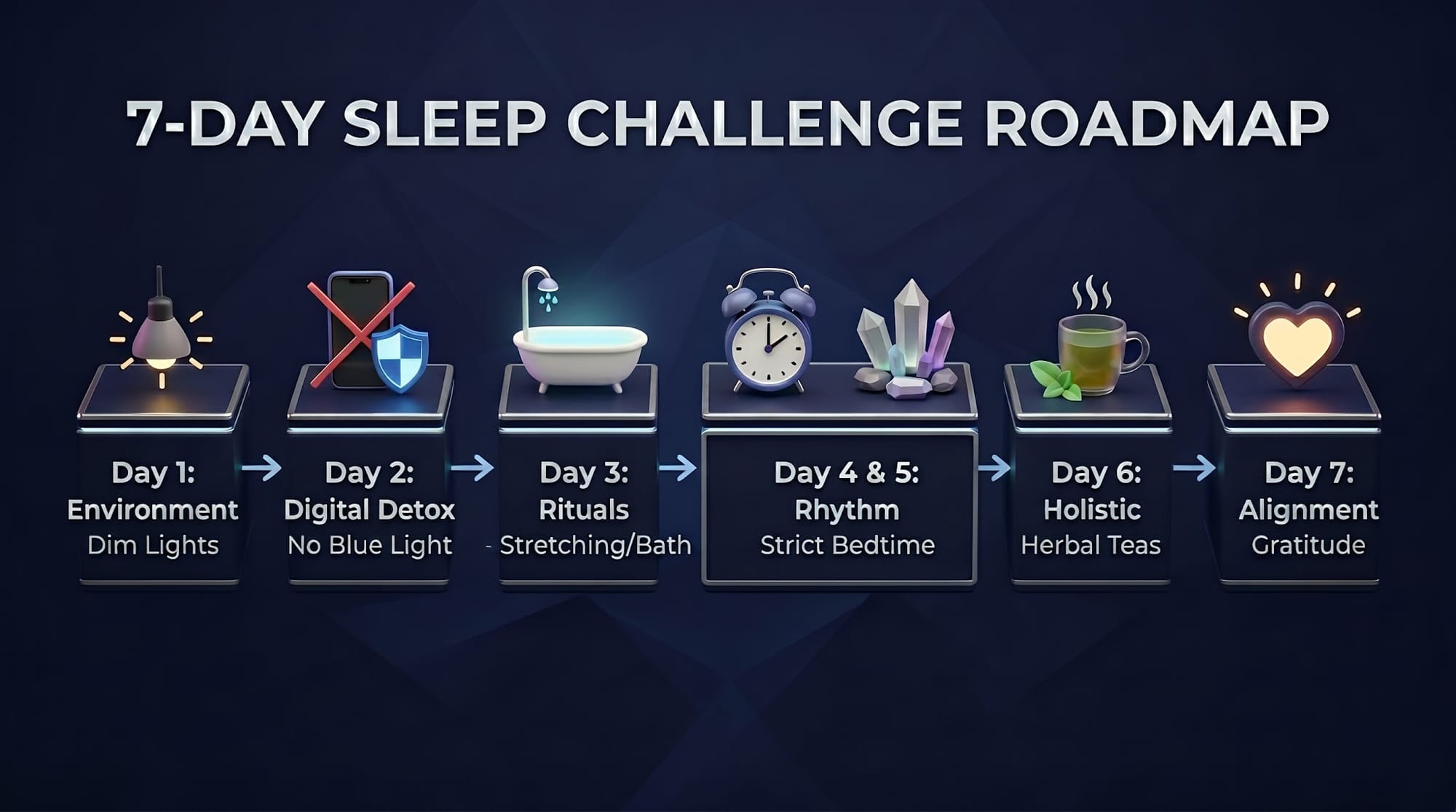
The best way to transform your rest is to build a personalized plan that honors your unique life. Use this 7-Day Sleep Challenge and daily checklist to experiment with different strategies and discover exactly what works best for you.
📅 The 7-Day Sleep Challenge
- Day 1: Start simple by dimming the lights in your home an hour before bed.
- Day 2: Disconnect entirely from screens to reduce exposure to blue light and energetic interference.
- Day 3: Choose and practice one calming bedtime ritual, like reading, stretching, or a short meditation.
- Day 4: Pick a consistent bedtime and wake-up time and stick to them to support your body's natural rhythm.
- Day 5: Focus entirely on your sleep environment—declutter, adjust the temperature, or add aromatherapy/crystals.
- Day 6: Try sipping a sleep-promoting tea or another herbal remedy as you wind down.
- Day 7: Practice gratitude before bed to gently shift your energy to a positive state.
Use a journal or this checklist to note your nightly activities and track how you feel when you wake up and during the day. Keeping track of these habits will offer incredibly valuable insights over time.
🚀 Elevate Your Sleep, Elevate Your Life

Good sleep is not a luxury; it is an absolute necessity for your physical, mental, and emotional health. It shapes your mood, fuels your daily productivity, and protects your long-term well-being. Choosing to make sleep a true priority is an important investment in your overall quality of life.
As you transition into rest tonight, carry this comforting affirmation with you:
"I honor my body and mind with the rest they need, trusting that quality sleep fuels my best self."
By combining proven, science-backed strategies with deeply nurturing holistic approaches, you can take full control of your sleep journey. Whether you choose to tweak your evening routine, improve your bedroom, or adjust your daily habits, every single intentional step you take brings you closer to balance, vitality, and deep peace.
🌟 Your Call to Action: Embrace Restorative Sleep Tonight!
Now that you know the science and have these helpful strategies, it's time to put them into practice:
- Commit to your schedule: Keep a consistent bedtime and wake-up routine, even on weekends, to regulate your body's natural energy flow.
- Optimize your space: Control the light, temperature, and noise to make your bedroom a peaceful place for rest.
- Build a calming routine: Spend the hour before sleep doing relaxing activities like reading, taking a warm bath, gentle stretching, meditation, or journaling.
- Honor your screen boundaries: Put devices away an hour before bed to support your natural melatonin production.
- Manage your stress: Practice mindfulness or gratitude to calm your mind.
- Track your journey: Notice how your daytime and nighttime habits impact how you feel. You can even explore dreamwork or set sleep intentions to deepen your connection with your inner world.
Choose just one small, practical step to start tonight. Each positive change supports your physical, mental, and emotional well-being, helping you feel healthier and more energized.
“Our actions and decisions today will shape how we will live. And so it is.”
Disclaimer: The information provided in this article is for educational, personal growth, and informational purposes only and is not intended as medical, psychological, or professional health advice. While we integrate science-supported strategies with holistic principles to enhance your lifestyle, this content should not be used to diagnose, treat, or manage any health condition or sleep disorder. Always consult with a qualified physician or healthcare professional regarding any medical concerns, changes to your routine, or before starting any new natural supplements or holistic practices.
If my writing made you pause, smile, or think, I’d love your support:
Your support helps me keep writing and sharing these ideas with you.
📚 Recommended Reads & Resources

Books (via Izalgo Bookstore)
Scientific Foundations & Sleep Physiology
- Why We Sleep: Unlocking the Power of Sleep and Dreams by Matthew Walker: This book serves as a cornerstone for understanding the fundamental biology of our nightly cycles. Walker explores the vital importance of both REM and deep sleep stages, mapping out how they regulate immune function, muscle repair, memory processing, and overall neurological longevity. It provides a rigorous scientific backbone to the concept that biological recovery is an active, non-negotiable requirement for physical health.
- Sleep: The Myth of 8 Hours, the Power of Naps, and the New Plan to Recharge Your Body and Mind by Nick Littlehales: Written by a premier sports sleep coach, this text challenges rigid assumptions about rest by introducing the concept of 90-minute sleep cycles. Littlehales provides a structural blueprint for evaluating your sleep in blocks rather than a flat hourly number, aligning perfectly with the idea that our bodies transition through specific biological and rhythmic intervals each night.
- The Sleep Revolution: Transforming Your Life, One Night at a Time by Arianna Huffington: Huffington addresses the cultural crisis of sleep deprivation, highlighting its profound impact on mental resilience and emotional health. By exploring the intersection of modern lifestyle demands, technology dependencies, and corporate burnout, the book demonstrates how reclaiming sleep acts as a critical biological intervention to restore personal presence and daily focus.
- The Nocturnal Brain: Nightmares, Neuroscience, and the Secret World of Sleep by Guy Leschziner: Through compelling clinical case studies, this neuroscientific exploration reveals what happens when the physical wiring of our nervous system misfires during the night. It offers an inside look at complex sleep disorders, illustrating how deeply our daytime cognitive function depends on the seamless structural transition between light, deep, and dream-state sleep cycles.
Metaphysical & Holistic Theories
- The Hidden Power of Dreams: How to Find Meaning, Your Inner Self and Your True Destiny by Denise Linn: This work treats nighttime dreaming as a sacred, intuitive landscape rather than mere psychological clutter. Linn provides frameworks for remembering, tracking, and deciphering the symbolic architecture of your dreams, complementing dream journaling to tap into the subconscious mind's deep wisdom.
- Vibrational Medicine: The #1 Handbook of Subtle-Energy Therapies by Richard Gerber: Gerber bridges standard biology with esoteric energy systems, establishing a conceptual framework for how subtle energetic fields influence physical health. The text offers a deep theoretical background on how the body's nervous system serves as the physical wiring for underlying metaphysical frequencies, illustrating how targeted energetic adjustments can calm an overstimulated aura.
- The Book of Chakra Healing by Liz Simpson: This comprehensive guide details the ancient mechanics of the body’s subtle energy pathways and meridians. Simpson focuses on how unexpressed anxiety, physical stress, and daily tension become trapped within our physical centers, offering direct metaphysical insights into how grounding rituals help open these meridians and discharge unexpressed survival energy.
- Crystals for Healing: The Complete Reference Guide by Karen Frazier. Frazier investigates the energetic principles behind mineral elements, exploring how the stable, geometric atomic structures of crystals interact with the spaces around us. The book outlines how utilizing specific vibrational elements in your immediate environment can actively absorb chaotic electromagnetic fields and harmonize your internal landscape before rest.
Practical "How-To" Elements & Habit Formation
- Atomic Habits: An Easy & Proven Way to Build Good Habits & Break Bad Ones by James Clear: Clear delivers a highly actionable masterclass on behavioral design, emphasizing that individuals do not rise to the level of their goals, but rather fall to the level of their established systems. This book provides the practical tools needed to build a reliable pre-bed routine, modify your sleep environment, and successfully stick to a consistent 7-day challenge.
- The Little Book of Hygge: Danish Secrets to Happy Living by Meik Wiking: This guide focuses on the intentional design of comfort, detailing how to create physical spaces that foster emotional safety and deep relaxation. Wiking provides immediate, practical advice on environmental management—such as lighting control, decluttering, and creating a cozy sanctuary—to signal to the nervous system that it is safe to unwind.
- The Mindful Day: Practical Ways to Find Focus and Calm the Chaos by Laurie J. Cameron: Cameron offers a direct menu of bite-sized mindfulness practices, breathing exercises, and reflection rituals that integrate seamlessly into a busy life. The text serves as an immediate user manual for actively managing stress, processing emotions early in the day, and anchoring a soothing evening ritual right before turning off the lights.
- The Yoga-Mind: 52 Essential Practices for Self-Discovery and Soothing Your Nervous System by Rina Jakubowicz: This practical guide pairs gentle physical movements with introspective reflection techniques to address physical tension. It provides an easy-to-follow layout for using restorative somatic stretches as physical mechanisms to release locked muscle knots, encouraging a smooth energetic flow throughout your entire system before bed.
Online Resources
Somatic Breakers & Heart-Brain Coherence
- HeartMath Institute / Inner Balance: This platform provides biometric tools and app-guided technologies designed to measure and improve heart rate variability (HRV) through intentional breathing. By offering real-time visual feedback, it acts as a literal somatic circuit breaker, transitioning the user from an anxious, chaotic "fight or flight" frequency to a state of measurable heart-brain coherence, making it an excellent practical tool for soothing an overstimulated nervous system before entering light sleep.
- Insight Timer: With an expansive library of guided tracks, this application features thousands of free meditation sessions, deep-breathing exercises, and sound-healing frequencies. Users can filter tracks by specific intentions—such as grounding energy or calming the mind's chatter—allowing for direct, customized regulation of their brain waves as they settle into a restorative state.
Habit Tracking & Routine Engineering
- Habitica: This platform gamifies real-life habits by turning your daily checklist and routines into an interactive RPG journey. It allows users to set custom milestones, making it highly effective for structuring and tracking consistency in a 7-day sleep challenge, maintaining a strict wake-up schedule, and managing evening nutrition.
- Pzizz: Utilizing psychoacoustics, this software generates dynamic, custom soundscapes composed of comforting words, gentle music, and binaural effects designed to match different stages of sleep. Its practical features adapt throughout the night to prevent tossing and turning, helping to relax your brain waves and smooth out your environment for uninterrupted rest.
Environmental Auditing & Circadian Alignment
- F.lux: This software automatically calibrates your computer screen's color temperature to match the sun's position based on your geographic location. By automatically filtering out disruptive blue wavelengths as dusk approaches, it acts as a digital boundary that supports natural melatonin production and prevents household electronics from overstimulating your evening awareness.
- Sleep Cycle App: Using intelligent sound analysis, this tool monitors your movements and breathing patterns throughout the night to track your progress through individual 90-minute sleep cycles. Its primary utility is a built-in sunrise alarm system that gently wakes you during your lightest phase of sleep, dramatically reducing sleep inertia and ensuring a vibrant transition into the morning.
Concise Learning & Summaries
- SoBrief.com: An AI-powered platform to quickly grasp the key takeaways of books related to energy management and well-being in about 10 minutes.
- Izalgo Bookstore: A curated digital space to find specific titles on holistic health and spiritual growth.
- Izalgo: This platform is a dedicated environment for exploring the harmonious integration of scientific, holistic, and metaphysical perspectives, presenting them as interconnected facets of a single truth. Through in-depth resources, it provides a central hub of concrete tools and practical advice to help you move from tension to deep inner tranquility.
Approach all books and resources with an open mind, recognizing that no single source is definitive, complete, or free from controversy and debate. Trust your intuition and inner guidance to discern what truly resonates with your personal path. If a concept or historical detail does not align with your truth, you are encouraged to disregard it and prioritize what best serves your growth.
SoBrief.com is an AI-powered digital platform that provides concise summaries of an extensive catalog of books, enabling users to grasp a book's key takeaways in about 10 minutes.
🔗Affiliate Note: Some links may be affiliate links, which means we may earn a small commission at no extra cost to you. Your support helps us continue this creative and healing work. Thank you!
Izalgo co-created the images in this post using AI software.
Copyright ©️IZALGO, LLC. All Rights Reserved