
Key Takeaways
- The paradox of success reveals that trying too hard often leads to failure; Zen Archery teaches that letting go is key to achieving goals.
- By shifting focus from outcomes to present actions, one can enter a state of Mushin, or ‘no-mind,’ which enhances performance.
- Zen Archery emphasizes the power of mindful presence and Wu Wei, encouraging actions to flow effortlessly rather than being forced.
- Practical applications of Zen Archery include sports, creative pursuits, and personal relationships, focusing on energy and authenticity.
- The article encourages readers to adopt practices like meditation and mindful movement to cultivate a deeper connection with themselves through Zen Archery.
Estimated reading time:13 minutes
Table of contents
- 🧘The Paradox of Success: Why You Miss the Target When You Try Too Hard
- ⚖️The Burden of Expectation
- 🌊The Power of Mindful Presence and Wu Wei
- 🥋Practical Applications of Zen Archery
- ☯️The Paradox of Achievement
- 🌱Mindfulness and Spontaneity: Cultivating the Ideal State
- 🔓Conclusion: Reclaiming Your Power Through Surrender
- 📣Call to Action: The 3-Step “Shoot for Nothing” Challenge
- 📚Recommended Reads & Resources
🧘The Paradox of Success: Why You Miss the Target When You Try Too Hard

Have you ever felt like the harder you try to achieve something, the further it seems to slip away? This frustrating paradox is something we’ve all experienced, whether in sports, work, or relationships. But what if there’s a way to break this cycle? What if the key to success lies not in trying harder, but in letting go? Zen Archery embodies this philosophy, teaching us precision and mindfulness by emphasizing the importance of letting go.
It’s not just a mental block; it’s an energetic one. When we chase something desperately, we vibrate with the energy of “lack”—signaling that we don’t have what we want—and the universe often responds by keeping the prize just out of reach.
In this article, we’ll explore the ancient wisdom of Zen archery (Kyudo) as taught by the philosopher Chuang Tzu. We’ll delve into how his teachings on mindfulness, detachment, and spontaneity can help you unlock your full potential. We will move beyond simple psychology and explore how aligning your energy and dissolving your ego can help you achieve greater success without the constant pressure to win.
⚖️The Burden of Expectation
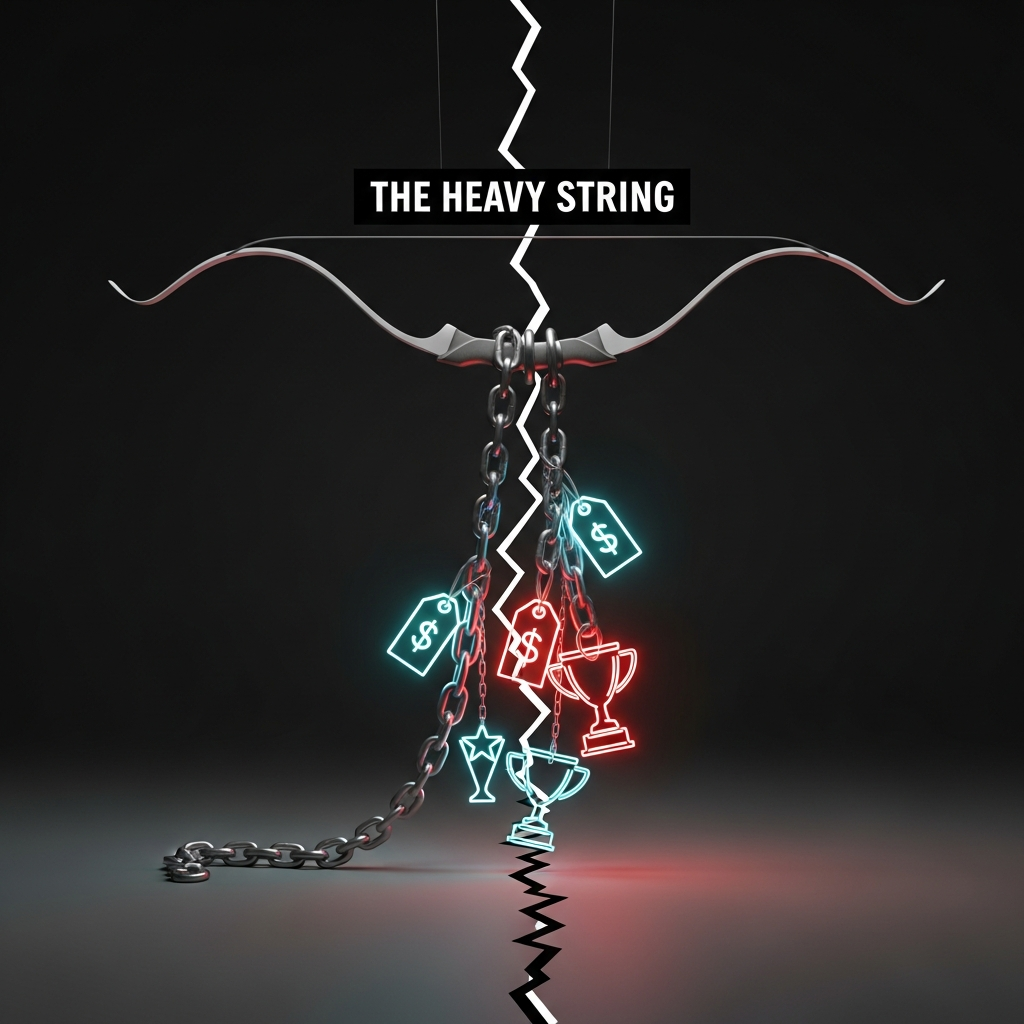
When we become fixated on achieving a specific outcome, we create a heavy burden of expectation. This isn’t just about nervousness; it is a metaphysical blockage known asDuality—a split between where you are and where you want to be.
When we obsess over the “prize,” we are feeding the Ego. The Ego loves to live in the future, obsessing over the applause or the paycheck. But your true power (Chi) only exists in the present moment. You cannot shoot an arrow yesterday or tomorrow; you can only shoot it now.
This burden manifests as:
- Increased anxiety and nervousness: The mind becomes rigid.
- Divided attention: We separate “us” (the shooter) from “it” (the target), creating a gap that is hard to bridge.
- Loss ofMushin: A loss of the “no-mind” state where intuition reigns.
- Diminished flow: We block the natural energy required for peak performance.
As Chuang Tzu wisely observed, “His skill has not changed. But the prize divides him. He cares. He thinks more of winning than of shooting – and the need to win drains him of power.” This rings true in all aspects of life; when the ego grips the bow too tightly, the arrow cannot fly true.
🌊The Power of Mindful Presence and Wu Wei

By releasing the need to win, we open ourselves to something far more potent than simple focus:Wu Wei, or “effortless action.”
In this state, we stop swimming upstream and start moving with the current of the universe. We realize that the target is not an enemy to be conquered, but a mirror of ourselves. This shift allows us to:
- EnterMushin (No-Mind): Clear the mind of calculated thoughts so that natural intelligence can take over.
- Access natural flow: Act not through muscular force, but through aligned energy.
- Dissolve separation: In this state, you realize there is no distance to cross. You, the bow, and the bullseye are part of a single, unified reality. Hitting the target isn’t an act of conquest; it’s an act of alignment.
- Respond spontaneously: Like a ripe fruit falling from a tree, the action happens automatically when the time is right, without “trying.”
Chuang Tzu’s ideal archer “shoots for nothing,” embodying a state of pure engagement where the distinction between the shooter and the mark dissolves.
🥋Practical Applications of Zen Archery

While these concepts are ancient, they are deeply applicable to modern life. Here is how to bring this holistic philosophy into your daily routine:
- Sports and Athletics: Shift your focus from “beating the opponent” to monitoring your internal energy. Remember that anxiety lives in the shallow breath of the chest, while power lives deep in the belly. Move from that center (theHara orDan Tien), not just your limbs.
- Creative Pursuits: PracticeWu Wei by viewing yourself as a vessel. You aren’t manufacturing the idea; you are channeling it. Let the art flowthrough you rather than trying to force itout of you.
- Professional Life: Focus on the quality of your contribution rather than the title or promotion. When you stop clamoring for status, your authentic work shines brighter.
- Personal Relationships: PracticeZanshin (the “remaining mind”). Think of this as the energetic “echo” of your spirit. Even after a conversation ends, do you leave behind a jagged, anxious energy, or a smooth, resonant calm? Be present during the interaction, and remain balanced regardless of the outcome.
☯️The Paradox of Achievement

Ironically, by letting go of the ego’s need to achieve specific results, we often perform better. We stop interfering with the natural unfolding of the moment. Consider the Law of Least Effort found in nature; grass doesn’t “try” to grow, it just grows.
Research supports this, showing that psychological detachment from work anxiety benefits well-being and job performance. Victory becomes a byproduct, not the objective. When you realize your worth is intrinsic and not tied to the target, you are finally free to shoot straight.
🌱Mindfulness and Spontaneity: Cultivating the Ideal State

The combination of mindfulness and spontaneity creates a powerful state of being. Cultivate this holistic alignment through:
- Meditation: Develop the ability to observe thoughts without attachment, quieting the “monkey mind.”
- Breathwork: In many ancient traditions, the word for “breath” and “spirit” is the same. Your breath is the thread that ties the physical body to the metaphysical spirit. Synchronize your actions with your breath to harmonize your vibration.
- Reflective Exercises: Examine where your ego seeks validation and how that attachment drains your power.
- Mindful Movement: Practices like tai chi or yoga emphasize moving from your energetic center rather than using brute force.
🔓Conclusion: Reclaiming Your Power Through Surrender

The lesson of Chuang Tzu is not that we should stop striving for excellence, but instead that we must stop strangling our potential with the fear of failure. The “need to win” is a heavy chain that restricts your natural movement and clouds your vision. True mastery—whether in the boardroom, on the field, or in your living room—arrives when you trust your training enough to let go of the outcome.
By shifting your gaze from the prize back to the bowstring, you reclaim the energy usually wasted on anxiety. You stop acting out of a deficit and start acting out of abundance. You realize that you do not aimat the target; you aim at yourself. The target was never really a piece of paper or a business metric—it was always a mirror. By mastering the bow, you are simply learning the self.
📣Call to Action: The 3-Step “Shoot for Nothing” Challenge

Don’t just read about Zen philosophy—apply it. For the next week, commit to this 3-step ritual to move from anxious expectation to powerful, energetic execution.
1. The “Process Over Prize” Task (Actionable)
- Task: Choose one high-pressure activity you perform this week (e.g., a sales call, a workout, a creative project).
- The Shift: Before you begin, write down the “Prize” (Ego validation) you are worried about on a piece of paper. Crumple it up and throw it away.
- The Action: Set a timer. Visualize the energy you were projecting onto that future goal reeling back into your body like a fishing line. Commit to focusing 100% on the mechanics and flow of the task.
2. The Anxiety Audit Log (Accountable)
- Task: Create a simple two-column log in your phone or notebook.
- Column A: “The Situation.”
- Column B: “The Attachment.”
- The Action: Every time you feel a spike of nervousness, log it. Identify exactly what external outcome your Ego is attached to that is causing the energy drain.
- Accountability: Review this log every evening. Acknowledge where you gave your power away and visualize how you will handle that situation withMushin (no-mind) tomorrow.
3. The “One Breath” Reset (Motivational)
- Task: Anchor your day with the “One Breath” technique.
- The Action: Before every meeting, email response, or difficult conversation, take one deep, conscious breath into your belly (Dan Tien). Feel your feet on the ground to anchor this metaphysical intent into physical reality. In that pause, remind yourself:“My worth is constant; the prize is a distraction.”
- The Goal: Complete this reset 5 times per day to maintain your spiritual alignment.
Start today. Pick up your bow, forget the target, and let your arrow fly.
“Our actions and decisions today will shape how we will live. And so it is.”
If my words made you pause, smile, or think,Buy Me a Coffee. It helps fuel my thinking and keeps my dream alive, one word at a time.🍵
📚Recommended Reads & Resources

Essential Reading: The Core Texts
- “Zen in the Art of Archery” by Eugen Herrigel
- The Connection: This is the definitive classic on the subject. It details the author’s six-year quest to learn Kyudo in Japan. It perfectly illustrates the document’s themes of “shooting for nothing” and the arrow shooting itself.
- “The Way of Chuang Tzu” by Thomas Merton
- The Connection: The document quotes Chuang Tzu regarding the archer who loses power when shooting for a prize. This book contains that specific parable (“The Woodcarver” and “The Archer”) and offers a poetic, accessible look at the philosophy of flow and detachment.
- “The Unfettered Mind: Writings on the Zen Master to the Sword Master” by Takuan Soho
- The Connection: Written by a Zen monk to a master swordsman, this book dives deep intoMushin (no-mind) and the importance of not letting the mind “stop” or fixate on the target or the opponent.
Modern Applications: Performance & Psychology
- “The Inner Game of Tennis: The Classic Guide to the Mental Side of Peak Performance” by W. Timothy Gallwey
- The Connection: This is the modern Western equivalent of Zen Archery. It distinguishes between “Self 1” (the critical Ego/Mind) and “Self 2” (the intuitive Body/Chi). It provides practical exercises for “letting go” of results to improve form.
- “Trying Not to Try: Ancient China, Modern Science, and the Power of Spontaneity” by Edward Slingerland
- The Connection: This book is dedicated entirely to the “Paradox of Achievement” mentioned in your document. It exploresWu Wei through the lens of cognitive science, explaining why trying harder often leads to failure.
- “The Art of Learning: An Inner Journey to Optimal Performance” by Josh Waitzkin
- The Connection: Waitzkin, a chess prodigy and Tai Chi world champion, discusses the concept of “making smaller circles” and using internal energy (Chi) to master high-pressure situations without anxiety.
Philosophy & Spiritual Growth
- “The Tao of Pooh” by Benjamin Hoff
- The Connection: A lighter, very accessible read that explains Taoist principles likeWu Wei (The Pooh Way) and the “Uncarved Block,” contrasting them with the rigid, anxious mind of the “Busy Backson” (The Ego).
- “Everyday Zen: Love and Work” by Charlotte Joko Beck
- The Connection: This book takes Zen out of the monastery and into the office and relationships. It is excellent for the “Practical Applications” section of your document, as it focuses on mindfulness in daily interactions.
Online Resources & Multimedia
Videos & Lectures
- Alan Watts – “The Archer” (YouTube/Audio Archives): The philosopher Alan Watts frequently lectured on Chuang Tzu and the parable of the archer. His talks are excellent for understanding the “Double Bind” of trying to force spontaneity.
- “One Shot. One Life” (Documentary): A documentary about the art of Kyudo that visually demonstrates the ritualistic, meditative aspect of the practice, where the target is a mirror.
- International Kyudo Federation (IKYF) Website: For readers interested in the literal practice of Japanese archery, this site offers videos of the Hassetsu (the eight stages of shooting), which demonstrate the physical embodiment of the philosophy.
Articles & Guides
- “Flow: The Psychology of Optimal Experience” (TED Talk by Mihaly Csikszentmihalyi): A short introduction to the scientific state of “Flow,” which correlates directly to the Zen state of Mushin.
- The Stanford Encyclopedia of Philosophy – Zhuangzi (Chuang Tzu): For a deeper, academic dive into the concepts of wandering, non-action, and the fasting of the mind.
Tools for Practice
- Waking Up (App by Sam Harris): Unlike other meditation apps that focus on relaxation, this one focuses on the nature of consciousness and “looking for the looker,” which aligns with dissolving the Ego and the subject-object duality mentioned in the post.
- Insight Timer: A free, helpful app for the “One Breath” reset challenge, allowing users to set bell intervals to remind them to return to the Dan Tien throughout the day.
SoBrief.com is an AI-powered digital platform that provides concise summaries of an extensive catalog of books, enabling users to grasp a book’s key takeaways in about 10 minutes.
Remember to explore these resources with an open mind and trust your intuition to find what resonates most deeply with your journey of rediscovery.
🔗 Affiliate Note: Some links on this page may be affiliate-based, allowing us to earn a small commission at no additional cost to you. Your support helps fuel this creative and healing mission—thank you!
Izalgo produced the images herein with AI-powered software.
Copyright©️ IZALGO, LLC All Rights Reserved